

Looking for an emulsification mixer for cream or lotion production? The right machine should match your formulation, target batch size, mixing requirements, heating and cooling process, and factory conditions, rather than only a motor rating or vessel capacity.
GRAND Machinery supplies vacuum emulsifying mixer configurations for customers evaluating equipment for cream, lotion and other viscous-product processes. This guide explains the main points to compare, introduces the CB100 100L Vacuum Emulsifying Mixer as an equipment example, and outlines the information needed to request a project-specific recommendation and quotation.
Request an Emulsification Mixer Quote · View the CB100
Quick Guide: What Should You Check Before Buying an Emulsification Mixer?
Before comparing suppliers, define the production requirement. Use this checklist to prepare an initial equipment discussion.
| Selection factor | What to define | Why it matters |
|---|---|---|
| Product and formulation | Product type, phase ratios and ingredient characteristics | These determine the mixing sequence and process conditions. |
| Target batch size | Normal, minimum and maximum batch | Working capacity differs from total vessel volume. |
| Viscosity and temperature | Viscosity at a stated temperature; heating and cooling needs | Material behaviour affects mixing and changes with temperature. |
| Homogenization | Dispersion objective and test method | The working head must be assessed against the product. |
| Agitation and circulation | Bulk movement and wall-scraping needs | Local high shear does not ensure movement throughout the vessel. |
| Vacuum requirement | Air entrainment and reduced-pressure processing needs | Vacuum conditions must suit the formulation. |
| Cleaning and contact parts | Cleaning method and material compatibility | Confirm these before finalizing the machine configuration. |
| Factory conditions | Power, utilities, space and downstream equipment | The system must fit the production environment. |
If you do not have every technical value yet, start with the product type, target batch size and installation country. GRAND can use these as the starting point for a project discussion; further details can be confirmed during technical review.
What Does an Emulsification Mixer Do?
An emulsification mixer is used to disperse one liquid phase into another liquid phase that does not readily mix with it. In an oil-in-water emulsion, for example, oil is dispersed as droplets in a continuous water phase. The formulation, including the emulsifier system, and the processing conditions both affect the resulting emulsion.
A vacuum emulsifying mixer may combine several functions in one production system:
- Homogenization: applies concentrated mechanical action to help disperse the phases.
- Slow-speed agitation: moves material through the vessel and supports overall batch circulation.
- Vacuum processing: can help remove entrained air when the formulation and process call for it.
- Heating and cooling: supports temperature-controlled processing.
- Vessel access and discharge features: support loading, inspection, transfer and cleaning arrangements, depending on the machine design.
These functions are related but not interchangeable. Vacuum does not create an emulsion by itself, and a high homogenizer speed does not automatically mean that the entire batch is being mixed uniformly. The equipment should be selected around the product and the required process.
For the underlying role of dispersed droplets and emulsifiers, see IKA’s explanation of emulsifying.
How to Choose the Right Emulsification Mixer
1. Start with the formulation and product requirements
Tell the supplier what you intend to manufacture. A face cream, body lotion and other viscous products may have different ingredient characteristics, phase ratios, temperature limits and quality requirements.
Useful information includes:
- Product type and intended application
- Oil-phase and water-phase ingredients, where available
- Approximate viscosity and the temperature at which it was measured
- Whether ingredients are heat-sensitive
- Required appearance, texture or other product-quality criteria
- Any existing laboratory or production trial results
A machine should not be declared suitable for every cream or lotion solely because it is described as a cosmetic emulsifying mixer. Material compatibility and process suitability need to be reviewed for the actual formulation.
2. Match working capacity to your batch size
Do not compare machines using vessel volume alone. A supplier may list both a working capacity and a larger total vessel capacity. These figures describe different things.
For an initial review, provide:
- Your normal production batch
- The smallest batch you expect to process
- The largest batch you expect to process
- Your desired number of batches per shift or day, if known
The required production output also depends on preparation, heating, mixing, cooling, transfer and cleaning time. A 100 L working-capacity label is not an hourly production guarantee.
3. Understand homogenization and bulk agitation
Homogenization and bulk agitation serve different purposes.
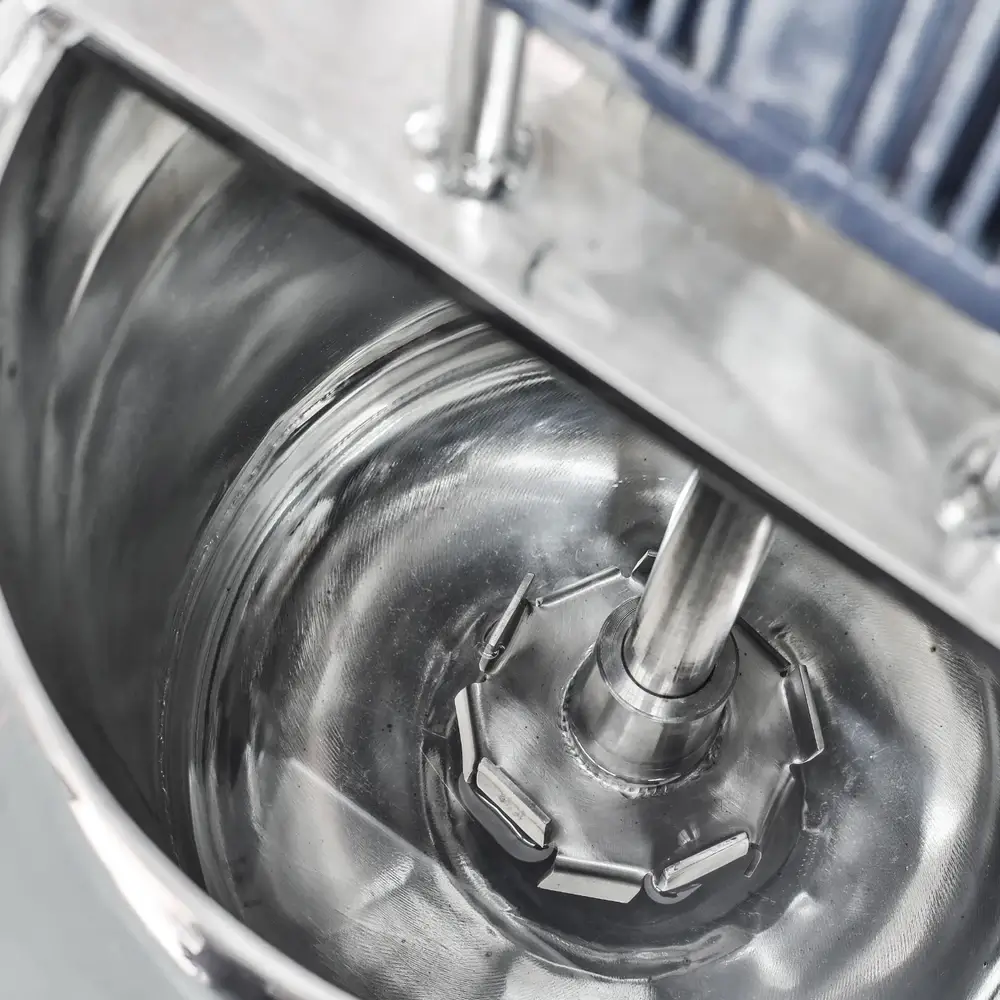
A high-shear working head creates intense local mechanical action to help break up and disperse droplets. The mixing action depends on the working-head design. In a rotor-stator system, material passes through a rotor-stator working zone.
A separate slow-speed agitator moves material through the vessel. Depending on the design, wall-scraping elements may help move product near the vessel wall.
When comparing suppliers, ask for the working-head type, agitator arrangement, speed range and the way the proposed configuration is intended to handle your material.
Why Homogenizer Speed Alone Does Not Determine Emulsion Quality
Two mixers running at the same rpm need not produce the same result. Compare the working head and the way material passes through it, alongside the formulation and process conditions.
| Factor | What to compare |
|---|---|
| Rotor tip speed | Compare rotor dimensions alongside rpm. |
| Working-head design | Ask how the proposed head creates shear and moves material. |
| Power input | Review the energy applied to the product, not only the installed motor rating. |
| Volume turnover | Consider how much of the batch reaches the active mixing zone. |
| Rheology and viscosity | State measurement conditions and how the material behaves during processing. |
Silverson’s scale-up guidance identifies these interacting factors and explains why one rule cannot reliably define scale-up. Use them to frame a technical comparison and an agreed trial plan.
4. Decide whether vacuum is needed
Vacuum can help manage entrained air in processes where reduced pressure is appropriate. It is not a substitute for homogenization, formulation design or quality testing.
Discuss the following with the supplier:
- Whether the product is prone to air entrainment
- At which process stage vacuum may be required
- The required pressure range and how pressure is referenced
- Whether the formulation has temperature or boiling-related constraints
- Which vacuum-related components are included in the proposed configuration
Do not compare vacuum figures without checking whether suppliers are quoting gauge pressure or absolute pressure.
For background on reduced-pressure mixing and air removal, see the Tetra Pak Dairy Processing Handbook.
5. Review heating and cooling requirements
Temperature affects viscosity, ingredient incorporation and product behaviour. The correct process profile depends on the formulation.
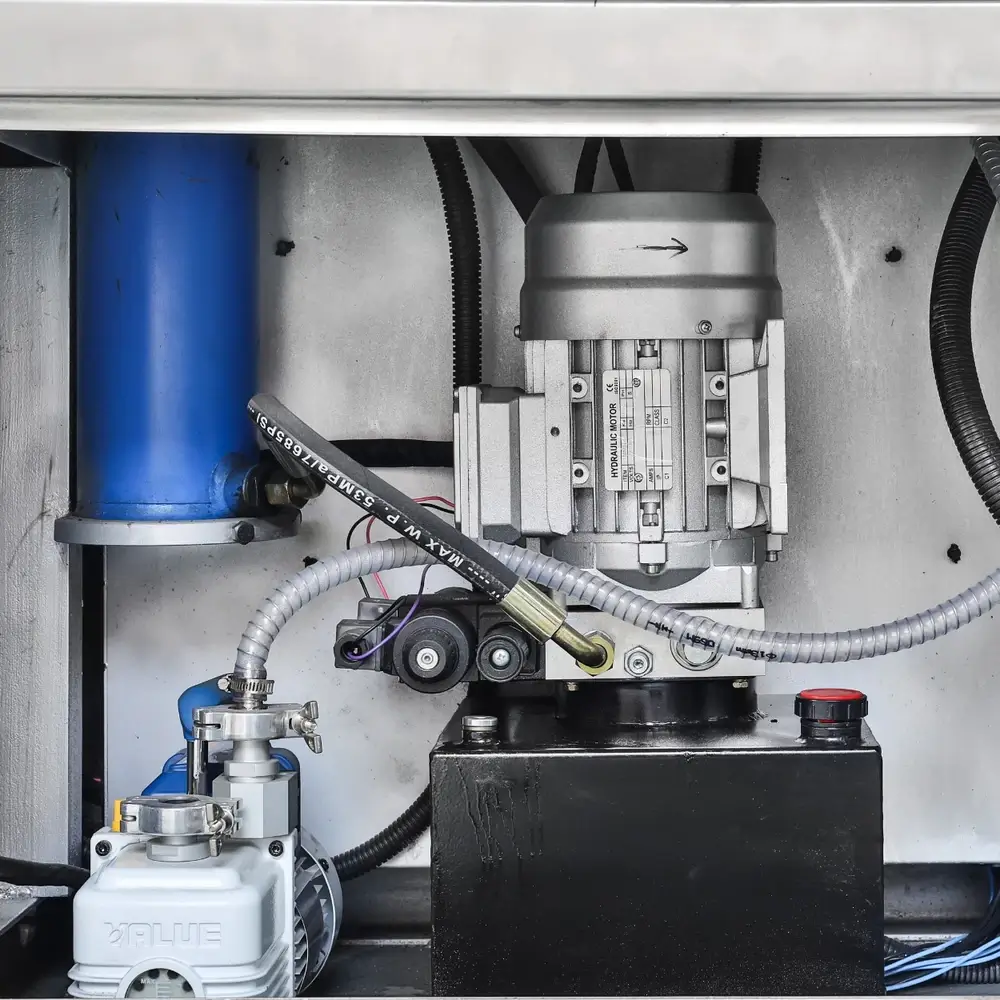
Provide the supplier with your heating and cooling requirements, including any temperature limits for sensitive ingredients. Confirm the heating method, cooling arrangement, available utilities and the measurement points included in the proposed system.
A machine’s maximum temperature rating should not be treated as the recommended processing temperature for your product.
6. Confirm cleaning, materials and factory integration
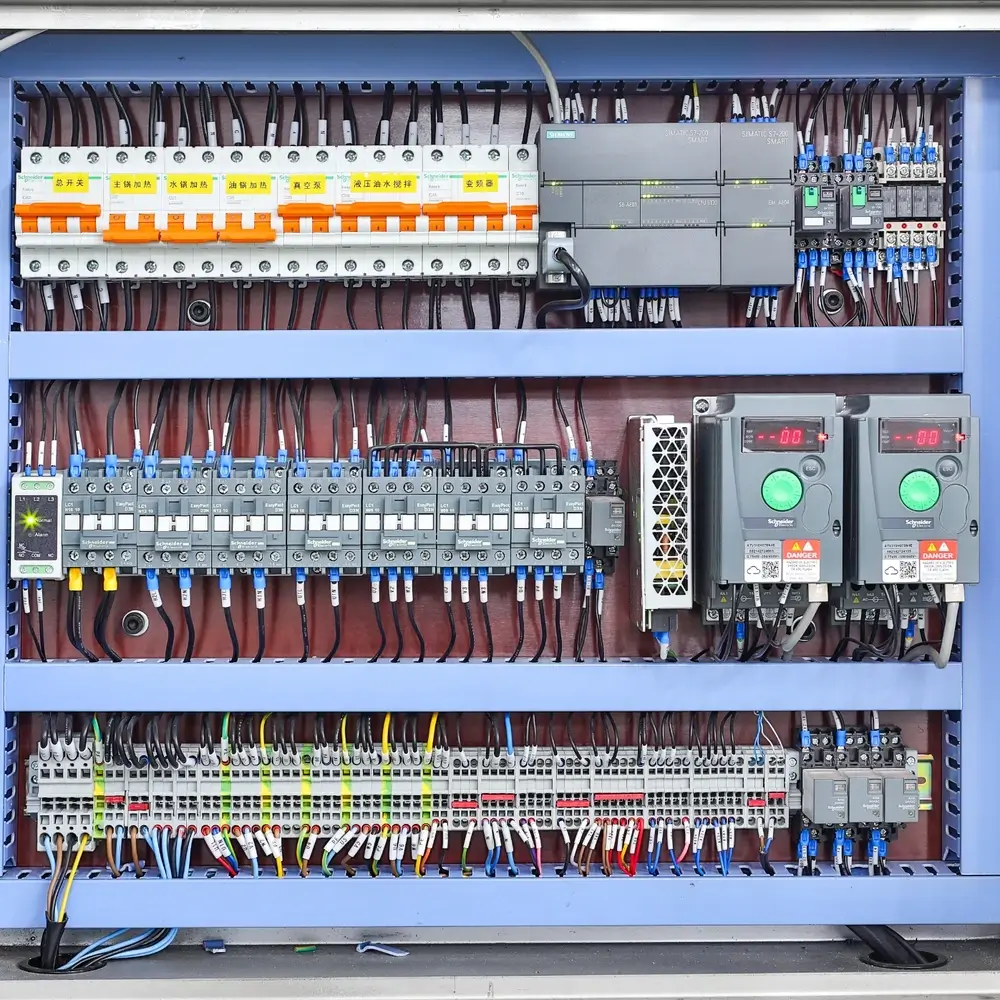
Before placing an order, review product-contact materials, seals, cleaning access, drainage and the cleaning method required by your production process. Confirm the electrical supply, installation footprint, operating access and how the mixer will connect to any filling or packaging equipment.
If cleaning validation, sanitary design documentation or specific certifications are required, list them in the enquiry and ask the supplier to confirm what can be provided for the quoted configuration. Do not assume that a feature or certification shown on another model is included.
Where CB100 Fits in the GRAND Mixer Range
Use working capacity as an initial comparison point, then review the usable batch range and configuration for your formulation. The table below compares models in the GRAND mixer range.
| Model | Working capacity |
|---|---|
| CB10 | 10 L |
| CB50 | 50 L |
| CB100 | 100 L |
| CB150 | 150 L |
Capacity alone does not establish equivalent mixing performance. Compare the vessel, agitator, working head, utilities and process cycle for each configuration. Explore the emulsifying mixer range if your required batch size differs.
Why Consider the GRAND CB100 Vacuum Emulsifying Mixer?
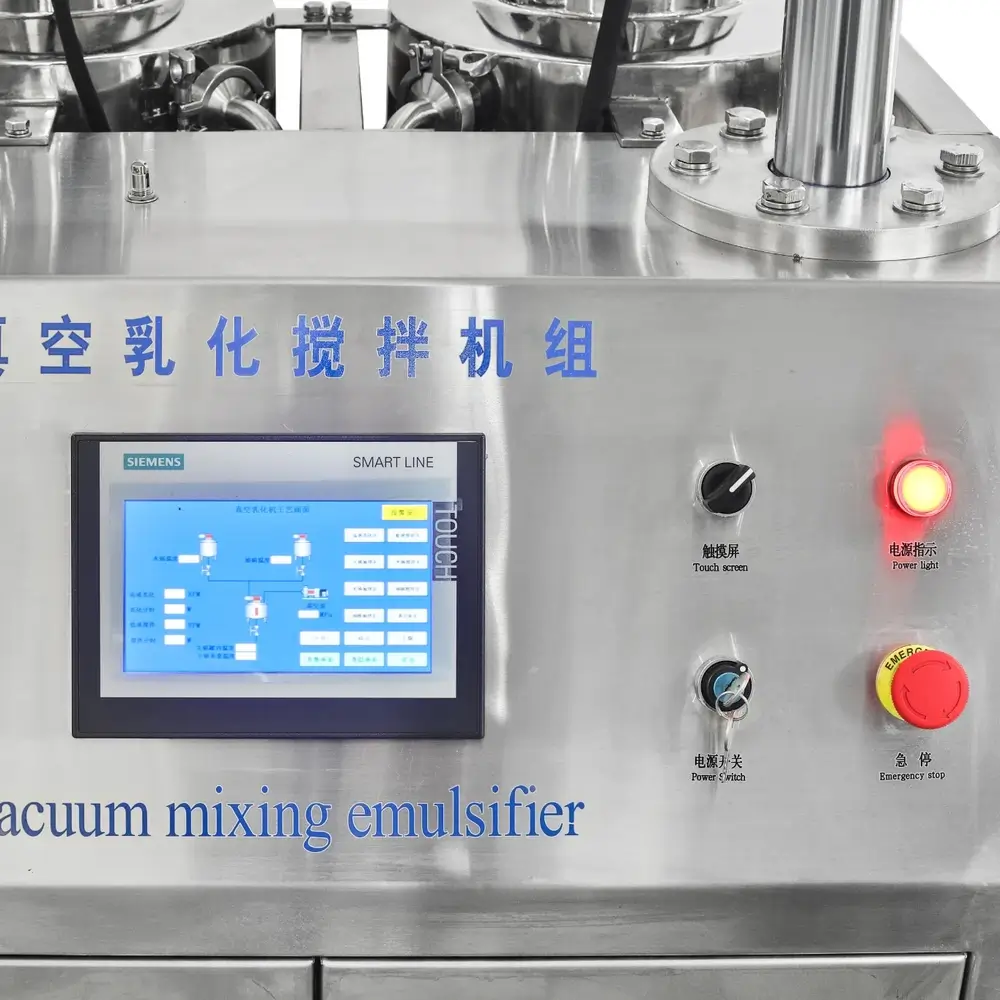
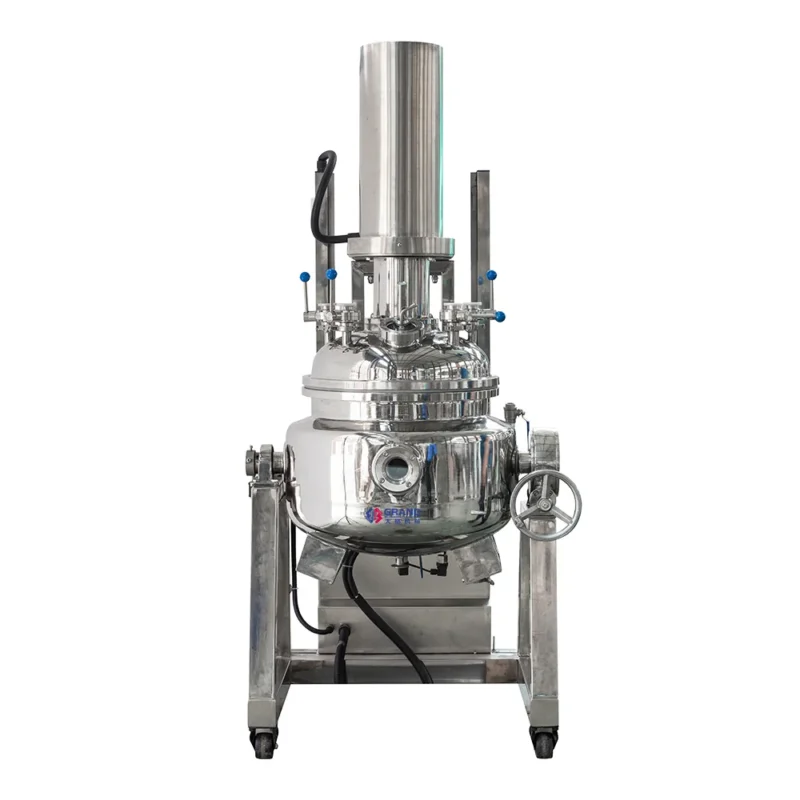
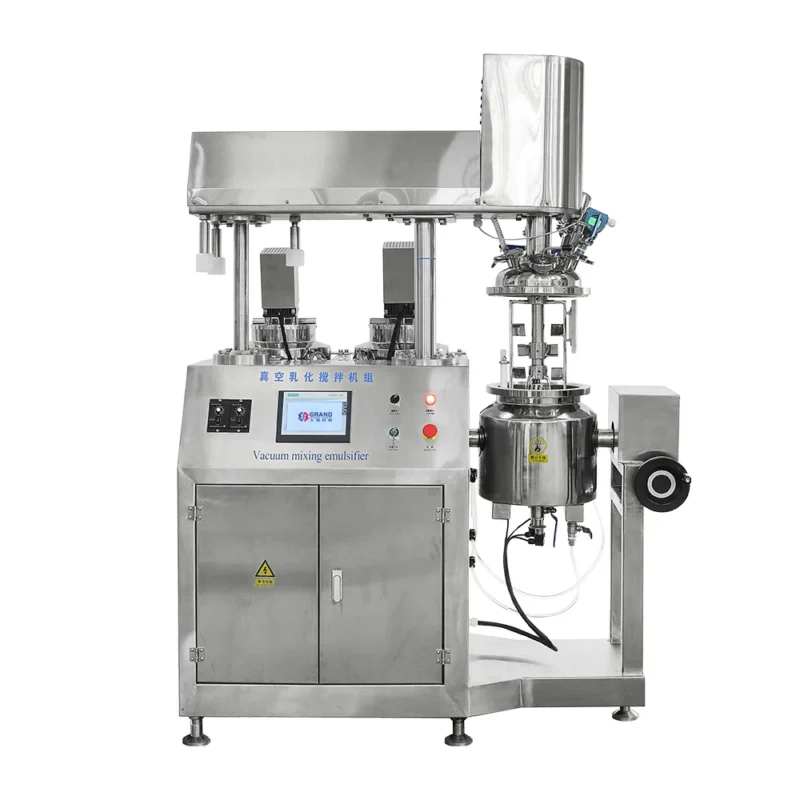
The GRAND CB100 100L Vacuum Emulsifying Mixer is one model to consider when reviewing a batch process for creams, lotions and other viscous formulations. Its published product-page configuration lists a main vessel, oil and water tanks, homogenization, slow-speed agitation, vacuum processing, heating and cooling, and hydraulic lifting and tilting.
CB100 specifications
| Item | Specification |
|---|---|
| Working capacity | 100 L |
| Oil tank capacity | 60 L |
| Water tank capacity | 80 L |
| Slow agitator motor power | 1.5 kW |
Compare these specifications with your batch size and process requirements. For more equipment details, view the CB100 product page.
What makes this configuration worth reviewing?
Separate oil and water tanks
The 60 L oil tank and 80 L water tank support separate phase preparation before combining the ingredients. Match the phase volumes and preparation sequence to the formulation.
Homogenization and slow-speed agitation
The CB100 uses a homogenizer for concentrated dispersion and a separate slow-speed agitator for overall vessel movement.
Vacuum and temperature-related functions
The published configuration includes vacuum processing, heating and cooling. These functions may be relevant when the process requires air management and controlled temperature changes. The required operating conditions must come from the formulation and be confirmed for the selected configuration.
Hydraulic lifting and tilting
The listed hydraulic arrangement provides a point for reviewing access, discharge and cleaning procedures. Ask GRAND to confirm the operating sequence, safety provisions and cleaning access for the proposed installation.
View the GRAND CB100 product page and specifications
Example Process Flow for Cream and Lotion Production
The UML activity diagram below outlines a typical cream and lotion batch process with separate phase preparation. Phase order, temperatures, mixing conditions, vacuum stages and late additions depend on the formulation.
Phase preparation, vacuum stages and process settings follow the approved formulation.
A useful trial record should link the formulation revision, batch size, addition sequence, temperature history, mixing stages, vacuum readings (where applicable), sampling method and test results. If the batch does not meet the agreed criteria, it should be held for review rather than automatically receiving more high-shear treatment.
Testing methods should match the product objective. Tetra Pak’s Mixing Product Development Centre describes droplet-size and viscosity measurements as part of its development work. Select evaluation methods that match the product-quality criteria.
Why Choose GRAND Machinery for Your Emulsification Mixer Project?
A named manufacturing company and a defined contact route
GRAND’s company and contact information identifies WENZHOU GRAND MACHINERY TECHNOLOGY CO., LTD. as the Wenzhou manufacturing company, based in Pingyang County, Wenzhou, Zhejiang, China. It identifies GRAND INTELLIGENT EQUIPMENT (GUANGZHOU) CO., Ltd. separately for Guangzhou sales and website support. The quotation should identify the entity responsible for your equipment and order.
A published mixer range with model-specific evidence
The CB10, CB50, CB100 and CB150 product pages provide a starting point for comparing working capacity and vessel size. The CB100 page also shows equipment details and operating footage. This lets buyers discuss a named configuration using identifiable model information. View the CB100 equipment page and request any additional drawings or configuration records needed for your review.
Equipment across processing and packaging stages
GRAND’s range includes emulsifying and mixing equipment, tube filling and sealing and cartoning equipment. For a cream or lotion project, these categories provide a basis for discussing equipment interfaces with the same team. Transfer arrangements, production balance and integration scope still need to be defined for the actual line.
A project scope that can be checked before ordering
Ask for the proposed model, materials, controls, utilities, options and exclusions to be recorded in the technical proposal. Agree separately on any product trials, inspection or factory acceptance testing, packing, commissioning, training and after-sales support. Record the agreed service scope, responsibilities and acceptance criteria in the quotation or service agreement.
Discuss your mixer project with GRAND
What Information Should You Send to Get an Emulsification Mixer Quote?
You do not need to prepare a complete engineering specification before making an initial enquiry. Start with the three essential details below.
| Essential information | Example |
|---|---|
| Product | Face cream, body lotion or another formulation |
| Target batch size | 100 L per batch |
| Installation country | Country where the equipment will be installed |
If available, add:
- Viscosity and measurement temperature
- Whether the product uses separate oil and water phases
- Heating and cooling requirements
- Whether vacuum processing is required
- Product-contact material or cleaning requirements
- Available electrical supply and utilities
- Factory space and equipment layout
- Existing upstream or downstream equipment
- Target delivery schedule and budget range
With this information, GRAND can begin reviewing the project, identify the points that need technical confirmation and discuss a suitable equipment configuration and quotation.
Frequently Asked Questions About Emulsification Mixers
What is the difference between an emulsification mixer and a vacuum emulsifying mixer?
An emulsification mixer is a broad term for equipment used to disperse one phase into another. A vacuum emulsifying mixer adds a vacuum arrangement to the equipment configuration. The actual functions, vessel design and included components vary by model.
Is a 100 L emulsification mixer suitable for my production?
It depends on your required batch size, formulation, usable working range and process cycle. The CB100 is published with a 100 L working capacity. Ask the supplier to confirm the suitable operating range for your material and process.
Does a higher homogenizer speed always produce a better emulsion?
No. The result depends on the working-head design, material properties, formulation, batch circulation and processing history. A maximum speed is not automatically the correct process setting. Establish the operating window through appropriate trials and product testing.
Do all cream and lotion formulations need vacuum?
No. Vacuum requirements depend on the formulation and process objective. Discuss air entrainment, product characteristics and the required process stages with the equipment supplier.
Can GRAND customize an emulsification mixer?
Configuration and options should be reviewed against the project requirements. Include the required capacity, materials, control functions, utilities, cleaning expectations and any special components in your enquiry. GRAND should confirm feasibility and the final scope in the technical proposal and quotation.
How can I get a quotation from GRAND Machinery?
Send your product type, target batch size and installation country through the GRAND contact page. Add viscosity, temperature, vacuum and cleaning requirements if available. The team can then review the information and discuss the proposed configuration and quotation.
Request an Emulsification Mixer Recommendation and Quote
Planning a cream or lotion production project? Tell GRAND what you need to manufacture, your target batch size and where the machine will be installed. If you are considering the CB100, mention the model in your enquiry.
The more process information you can provide, the easier it is to review the equipment configuration. You can start with a brief enquiry and supply detailed formulation or engineering information during the technical discussion.
Send your requirements to GRAND Machinery to discuss a suitable emulsification mixer configuration and request a project-specific quotation.
Request a Quote · View CB100 Specifications · Explore GRAND Emulsifying Mixers
Technical References
- GRAND Machinery — CB100 100L Vacuum Emulsifying Mixer. Source for the published CB100 model description, specifications and product image.
- GRAND Machinery — Emulsifying Mixers. Source for the product range.
- GRAND Machinery — Contact Us. Enquiry route.
- IKA — Emulsifying. General explanation of emulsion formation and emulsifier function.
- Silverson — Is There a Formula for Scale-up?. Factors affecting scale-up.
- Tetra Pak — Dairy Processing Handbook: Mixers. General mixing, vacuum, shear and temperature considerations.
- Tetra Pak — Product Development Centre, Mixing Solutions. Examples of emulsion evaluation and mixing development.



Sales Manager