
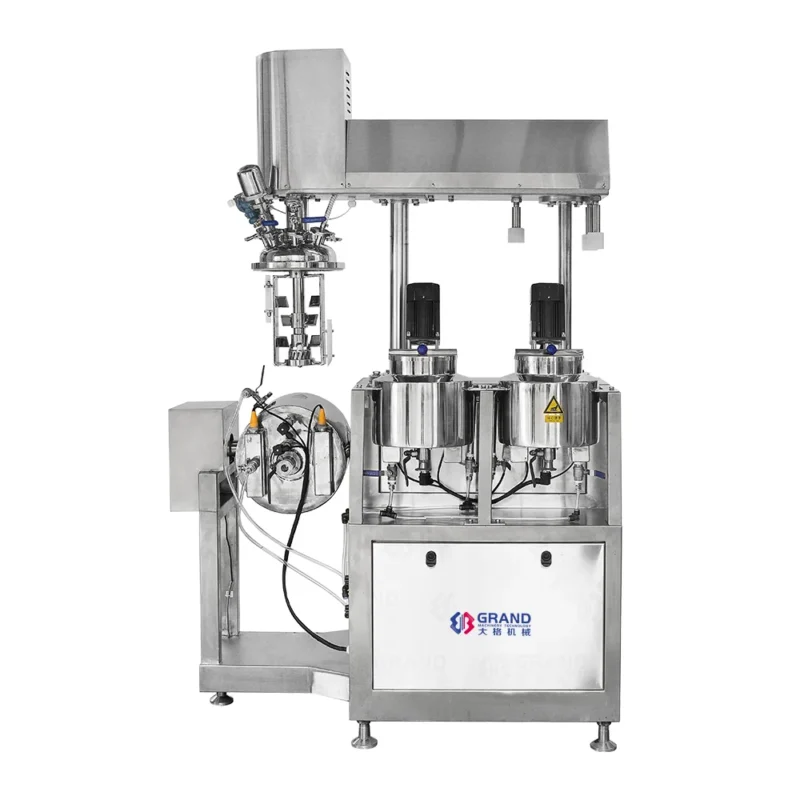
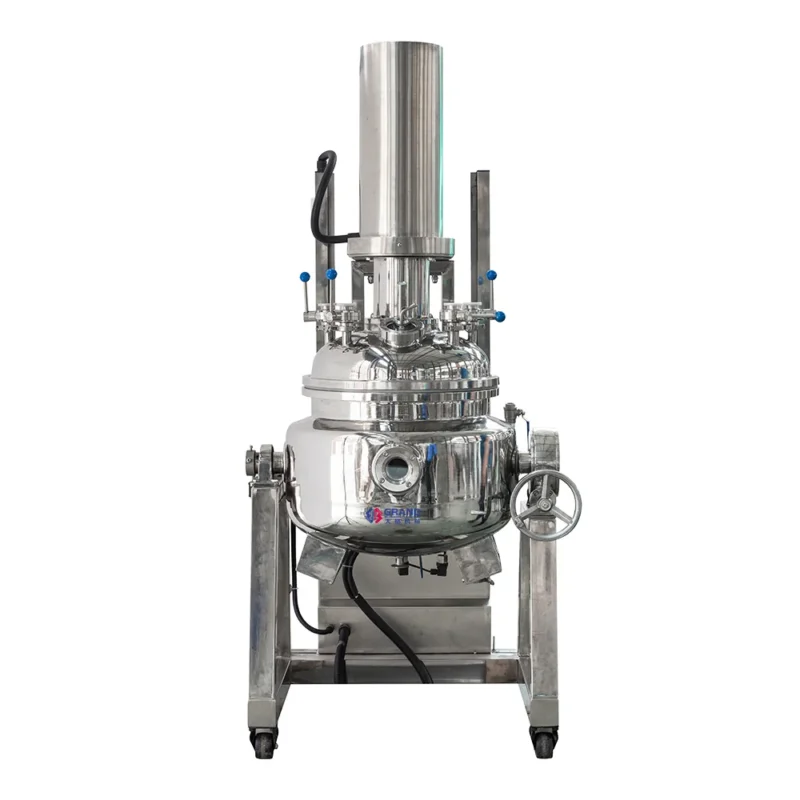
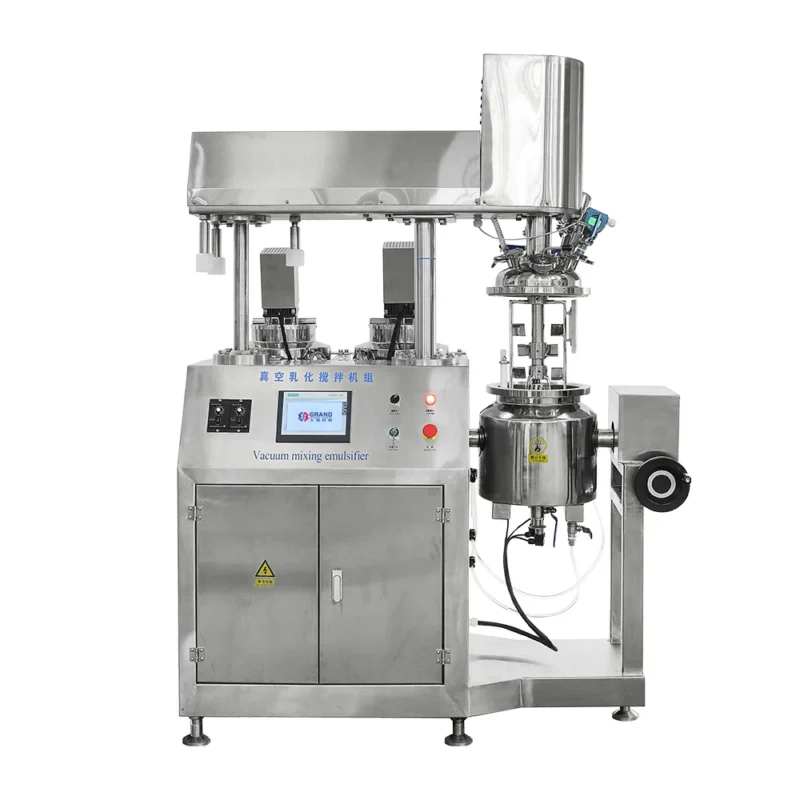
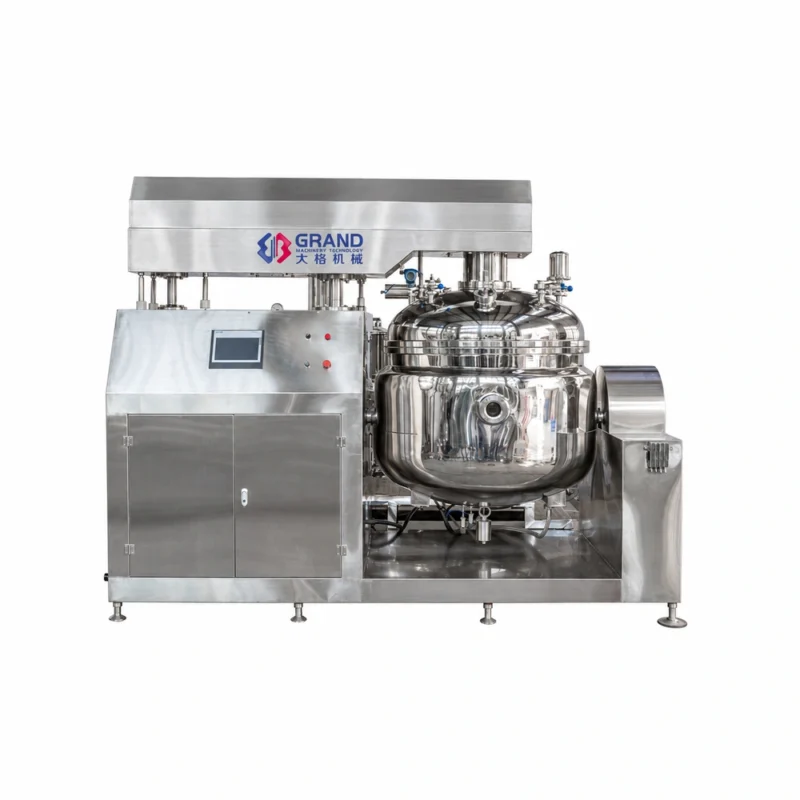
Vacuum Emulsifying Mixers for Creams, Lotions and Ointments
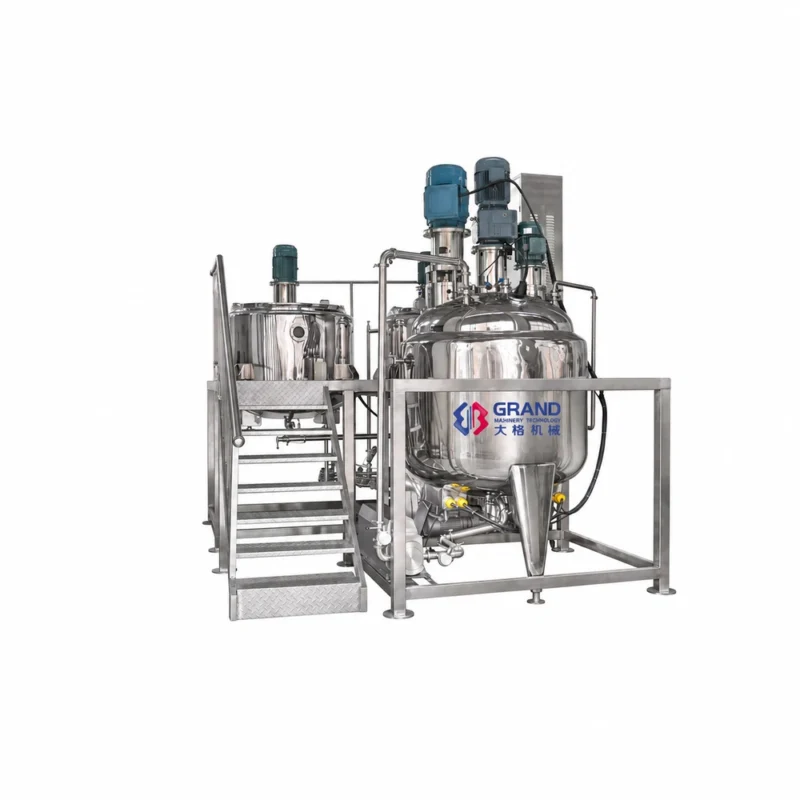
GRAND Machinery Technology vacuum emulsifying mixers support cream, lotion and ointment production, from small batches to larger mixing systems. Explore six models, including the CB500 with a 500 L working capacity and the CB2000 with a 2,000 L equipment volume. Match the mixer and process configuration to your formulation.
- 6 models: CB10 to CB2000
- Emulsifying speed up to 3,500 rpm
- Configured for your formulation
Emulsifying Mixer Systems Built Around Your Formulation
From small-batch mixers to CB500 and CB2000 production systems, GRAND Machinery Technology helps you select mixing and emulsifying equipment around your formulation, batch size and production plans.
Choose the Right Emulsifying Mixer Capacity
Compare six vacuum emulsifying mixer models: CB10, CB50, CB100, CB150, CB500 and CB2000. Match working batch capacity, mixing power and configuration to your formulation.
10L Vacuum Emulsifying Mixer
Compact system for small-batch production of creams, lotions and other viscous formulations.
- 10 L working volume (20 L main pot)
- Homogenizer 0–3,500 rpm
- Separate 10 L water and oil phase tanks
- SUS316L main vessel contact surfaces
50L Vacuum Emulsifying Mixer (Lift-Type)
Lift-type design with motor-driven screw lifting and variable-speed frame scraper agitation.
- 50 L working volume (70 L main pot)
- Homogenizer 0–2,800 rpm
- SUS304 inner vessel, jacket and cladding
- Electric heating, tap-water cooling
100L Vacuum Emulsifying Mixer
Production-scale mixer with hydraulic lifting and tilting for easier discharge and cleaning.
- 100 L working capacity (160 L main vessel)
- Homogenizer 0–3,500 rpm, 3 kW
- 60 L oil tank and 80 L water tank
- SUS316L inner vessel (5 mm), PU foam insulation
150L Vacuum Emulsifying Mixer
Larger-batch system with hydraulic lifting, a CIP cleaning head and configurable heating.
- 150 L working capacity (220 L main vessel)
- Homogenizer 0–3,500 rpm, 3 kW
- SUS316L inner vessel, 5 mm
- Steam or electric heating, water cooling
500L Vacuum Emulsifying Mixer
500 L production system with frame agitation, high-shear homogenization and a separate oil pretreatment tank.
- 500 L working volume (620 L main vessel)
- Homogenizer 7.5 kW, 0–3,000 rpm
- Frame agitator 3.7 kW, 0–50 rpm
- 500 L oil pretreatment tank
2000L Vacuum Emulsifying Mixer
Large-volume mixing system for creams, lotions and ointments, with a 22 kW emulsifying motor and 7.5 kW mixer.
- 2,000 L equipment volume
- Emulsifying motor 22 kW, 0–3,500 rpm
- Mixer motor 7.5 kW, 0–60 rpm
- Access platform and staircase
Not Sure Which Emulsifying Mixer Fits Your Batch?
Tell us your product type, viscosity, batch size and heating needs. We will recommend a suitable vacuum emulsifying mixer model and configuration.
PRODUCTION CHALLENGES
Solving Common Challenges in Cream, Lotion and Ointment Mixing
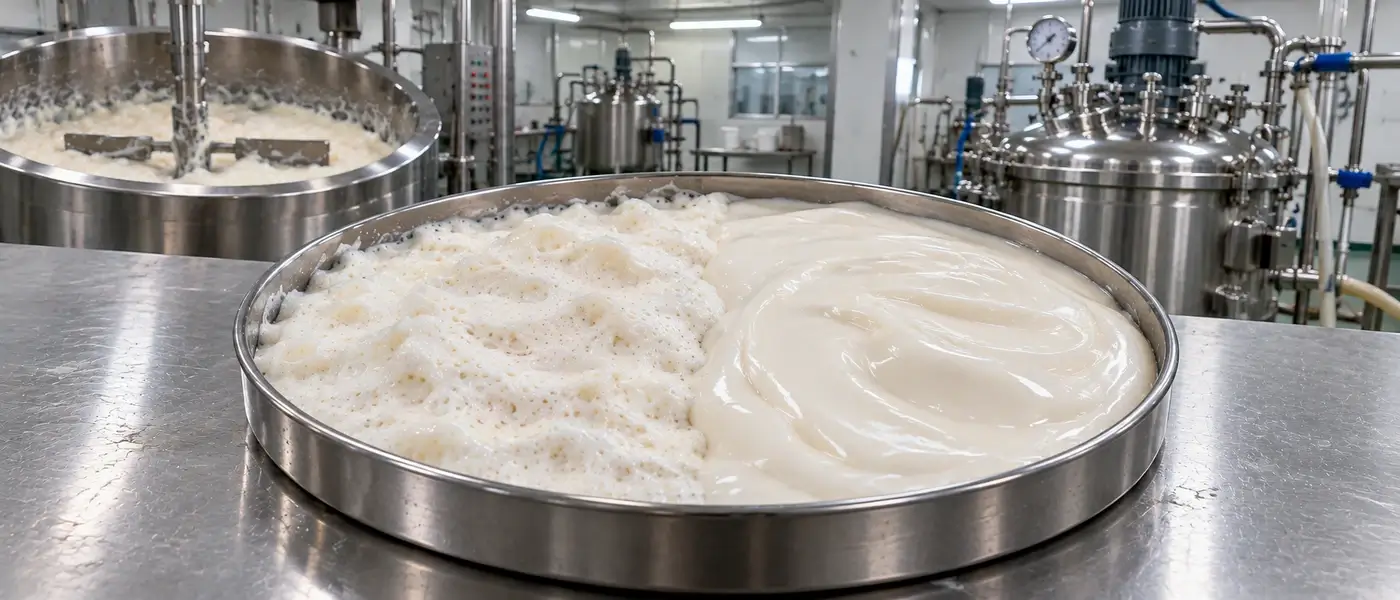
Air Bubbles and Uneven Texture
Mixing viscous creams and lotions in open tanks can trap air, causing bubbles, foaming and an uneven, dull finish in the final product.
HOW OUR MIXERS HELP
Mixing and homogenizing under vacuum helps remove entrapped air, so creams, gels and ointments come out smoother and more uniform.
PRODUCTION BENEFITS
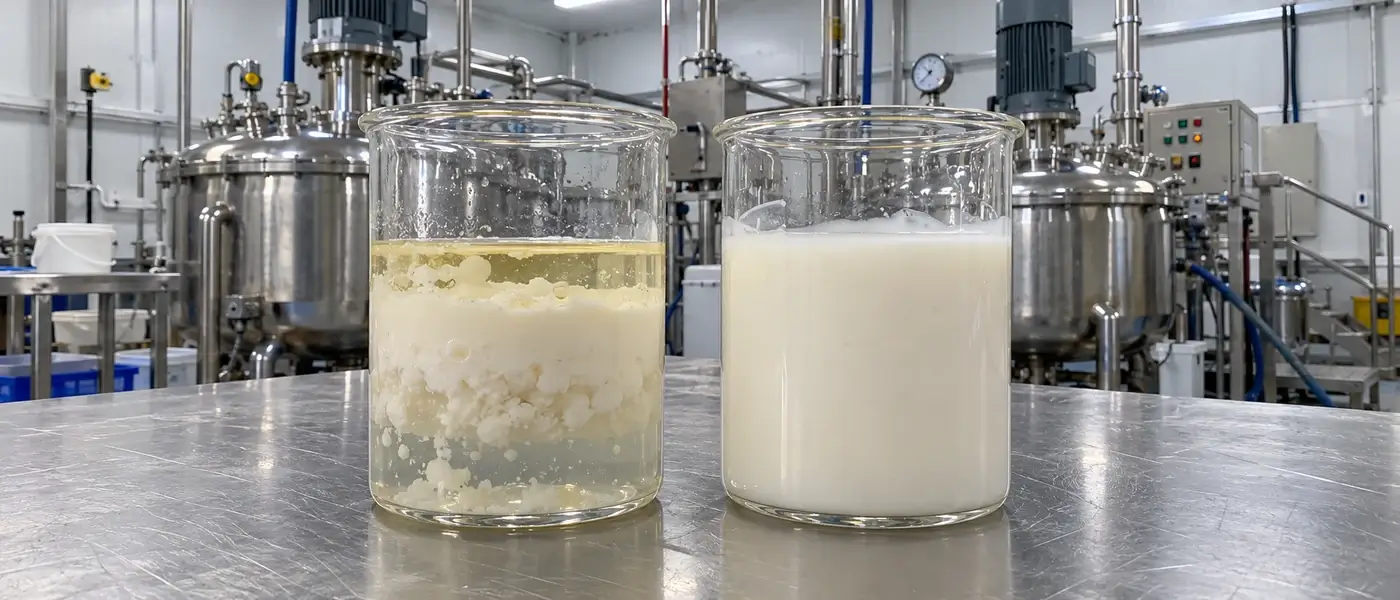
Unstable Emulsions and Phase Separation
When oil and water phases are not fully dispersed, products can separate in storage, turn grainy or vary from one batch to the next.
HOW OUR MIXERS HELP
High-shear emulsifying, with speeds up to 3,500 rpm depending on the model, helps disperse droplets. Separate agitation keeps the batch moving for more uniform processing.
PRODUCTION BENEFITS
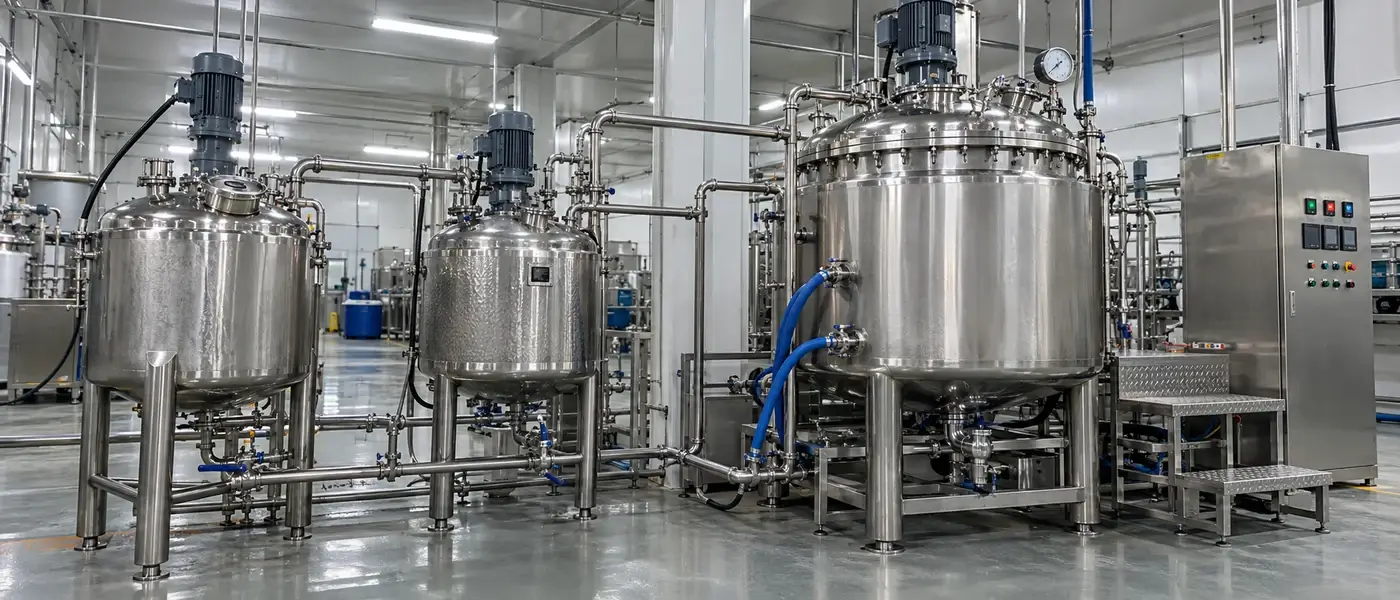
Heating, Cooling and Long Batch Cycles
Many formulations need the oil and water phases heated separately, then cooled under control. Manual heating and transfers lengthen batches and affect consistency.
HOW OUR MIXERS HELP
Separate oil and water phase tanks on the CB10, CB100 and CB150, plus a jacketed main vessel with electric or steam heating and water cooling, keep each stage within one closed system.
PRODUCTION BENEFITS
Difficult Discharge and Cleaning
Sticky, high-viscosity products cling to vessel walls, which slows discharge and makes cleaning between formulations time-consuming.
HOW OUR MIXERS HELP
Wall-scraping agitators, lifting vessel lids and tilting or positive-pressure discharge on larger models help empty the vessel, and the CB150 adds a CIP cleaning head.
PRODUCTION BENEFITS

Automatic CIP Cleaning System
Plan a dedicated cleaning station alongside your mixing equipment. Explore the solution tanks, circulation components and controls used to build a CIP circuit.
Share your product, vessel capacities and cleaning requirements.
View CIP Cleaning SystemPlanning a Cream or Ointment Production Line?

Share your formulation, target batch size and utilities. We will propose a suitable mixer model and options, and advise on tube filling and packaging equipment for the rest of your line.
Emulsifying Mixer Applications by Industry
Vacuum emulsifying mixers are used wherever smooth, stable emulsions and pastes are needed, from skincare creams to topical ointments and food sauces.
Pharmaceutical
Ointments, creams, gels and other topical preparations that need uniform dispersion and air-free mixing.
Cosmetics & Personal Care
Face creams, body lotions, hair conditioners, sunscreens and makeup bases with a smooth, stable texture.
Food Processing
Mayonnaise, salad dressings, sauces and other emulsified food products.
Daily Chemical
Hand creams, shampoos, shower gels, liquid soaps and other viscous household care products.
Healthcare Products
Medical gels, skin-care ointments and other creams for healthcare and wellness use.
Chemical Products
Polishes, pastes, coatings and other viscous chemical emulsions.
WHY CHOOSE GRAND
An Emulsifying Mixer Manufacturer You Can Rely On
GRAND Machinery Technology supplies vacuum emulsifying mixers and matching filling and packaging equipment, configured around your formulation, batch size and plant layout.
Hygienic, Durable Construction
Stainless steel vessels in SUS316L or SUS304, jacketed construction and PU insulation, built for daily production and easy cleaning.
Configurable Options
Choose batch capacity, heating method, lifting and discharge style to match your formulation and workflow.
Process Guidance
Practical advice on homogenizer speed, vacuum, heating and cooling settings for your product.
Model Selection Assistance
From small batches to larger production volumes, we help you match batch size, viscosity and output to the right emulsifying mixer.
OUR PRODUCTS
From Mixing to Filling and Packaging
Pair your vacuum emulsifying mixer with GRAND tube filling and sealing, cartoning, case packing and inspection machines for a complete cream and ointment line.
FAQ / EMULSIFYING & MIXING
Vacuum Emulsifying Mixer FAQs
Common questions about batch capacity, homogenizing, vacuum mixing, heating and cooling, and vessel materials.
What products can a vacuum emulsifying mixer produce?
Our vacuum emulsifying mixers are designed for creams, lotions, ointments, and other viscous formulations used in cosmetic, personal care, pharmaceutical, food, and chemical production.
Which batch capacities are available?
The CB10, CB50, CB100, CB150 and CB500 offer working capacities of 10 L, 50 L, 100 L, 150 L and 500 L respectively. The CB2000 has a 2,000 L equipment volume. Working batch capacity and total equipment volume are different measures; choose a model around your formulation, batch size and process requirements.
Why is mixing done under vacuum?
Mixing and homogenizing under vacuum helps reduce air entrapment in viscous products, which supports a smoother texture and more consistent appearance.
How fast does the homogenizer run?
The CB10, CB100 and CB150 list homogenizer speeds up to 3,500 rpm; the CB50 lists up to 2,800 rpm and the CB500 up to 3,000 rpm. The CB2000 emulsifying motor runs at 0–3,500 rpm. Choose the operating speed and agitation settings to suit your formulation.
Do the mixers include heating and cooling?
The CB10, CB100, and CB150 integrate heating and cooling systems, and the CB50 lists electric heating with tap-water cooling. Confirm the heating method and the temperature range your process requires when you request a quotation.
What materials are used for the mixing vessel?
The CB10, CB100, and CB150 use SUS316L stainless steel for the main inner vessel (5 mm on the CB100 and CB150). On the CB100, the middle jacket (3 mm) and outer cladding (2 mm) are SUS304, with PU foam insulation. The CB50 uses SUS304 for the inner vessel, jacket, and cladding. Let us know any material requirements for your industry.
How is the vessel lid lifted for cleaning and discharge?
Lifting systems vary by model: the CB100 uses hydraulic lifting and tilting, the CB150 uses hydraulic lifting, and the CB50 uses motor-driven screw lifting. Consider cleaning access, discharge method, and available space.
GET IN TOUCH
Get Your Emulsifying Mixer Quote
Tell us about your product, target batch size, viscosity and heating method. We will recommend a suitable vacuum emulsifying mixer and prepare a quotation for you.
- Model and capacity selection
- Process and configuration review
- Project-specific quotation