
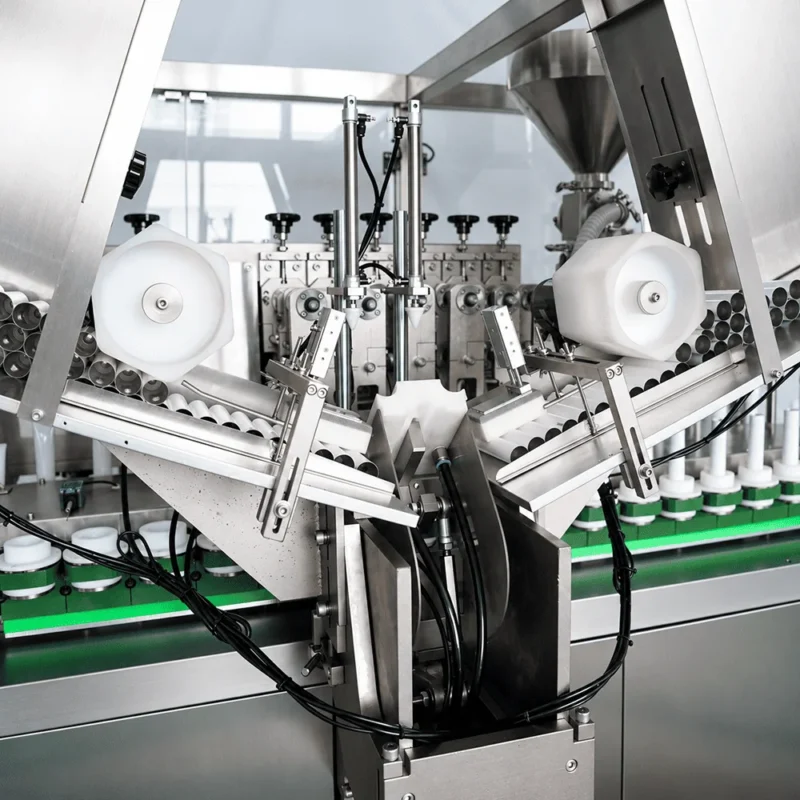
Choosing a cosmetic packaging machine starts with the pack you need to sell. A cream in a laminated tube, an aluminum tube in a folding carton, and a film-wrapped carton set require different equipment decisions. Define the product, packaging materials and required finished output before comparing machine speeds.
This guide focuses on cosmetic creams, gels and pastes packed in tubes, with cartoning and optional film overwrapping. It compares the GRAND GD120-A and GD120-Z tube-filling configurations, the GDS120 horizontal cartoner and the GDST450 overwrapping machine. Use the specifications and selection checks below to prepare a practical enquiry for a single machine or a coordinated packaging project.
Planning a cosmetic packaging project? Request a Cosmetic Packaging Machine Quote. Share your product, tube material, fill quantity and target finished packs per minute.
Quick Selection Guide
Swipe horizontally to view all columns.
| Your packaging requirement | Equipment to evaluate | Key selection check |
|---|---|---|
| Cream or gel in plastic or laminated tubes | GD120-A | Hot-air sealing; product characteristics, fill weight and tube dimensions |
| Product in aluminum tubes | GD120-Z | Mechanical folding; fill volume and aluminum-tube dimensions |
| A compatible product packed in a folding carton | GDS120 | Carton dimensions, product orientation and the feeding arrangement |
| Film around an individual carton or carton group | GDST450 | Finished pack dimensions, grouping pattern and heat-sealable film |
The first two rows describe alternative tube-filling configurations. Cartoning and overwrapping are additional stages when the final pack requires them. Equipment selection should follow the approved package design, rather than adding every available machine to the line.
If the cream or lotion also needs batch preparation, review the emulsifying and mixing equipment range separately. The emulsification mixer buying guide explains formulation, working capacity and process conditions upstream of filling.
Start with the Product and Final Pack
Define the material that reaches the filling nozzle
Provide the product type, target filling temperature and viscosity measured at a stated temperature. Describe particles, foaming behaviour, stringing or any sensitivity to heat. These details help frame the filling discussion: two products sold as hand cream can behave differently during dosing and nozzle withdrawal.
Give the nominal quantity and the acceptance tolerance in the units you actually use. A filling range stated in grams is a mass range; a range stated in millilitres is a volume range. Converting between them requires the product density under the relevant conditions. Avoid selecting a filling system from the number alone.
Measure the tube, carton and wrapped pack separately
Supply tube samples or drawings showing diameter, length, cap shape, shoulder geometry and material construction. Include the intended seal or fold and the space available at the tube tail. For printed tubes, provide the artwork and any registration-mark requirements.
For cartoning, use the finished, filled and sealed tube dimensions and the carton drawing, including internal clearance. The GD120-A tube-length range reaches 200 mm, while the GDS120 carton-length range reaches 155 mm. Those upper limits do not establish a compatible combination. Insertion direction, cap size, folded or sealed tail, leaflet and available carton space all need a dimensional review.
For overwrapping, measure the outside dimensions of the carton or complete carton group in its proposed orientation. A group of cartons is a different pack from one carton, so it needs its own size and output definition.
GD120-A vs GD120-Z: Match the Sealing Method
The GD120 product page lists two distinct configurations. Use the relevant column when assessing a cosmetic tube application.
Swipe horizontally to view all columns.
| Specification | GD120-A | GD120-Z |
|---|---|---|
| Tube material | Plastic / laminated tubes | Aluminum tubes |
| Sealing method | Hot-air sealing | Mechanical folding |
| Production speed | 80–110 tubes/min (typical) | 80–120 tubes/min |
| Filling range | 3–250 g | 3–180 mL |
| Tube diameter | 12–50 mm | 13–30 mm |
| Tube length | 80–200 mm | 50–180 mm |
| Filling system | Dual independent piston filling units | Automatic filling system |
| Filling accuracy | ±1% for fills of 30 g or above | Contact GRAND for the application specification |
| Control system | Siemens PLC and touchscreen | Siemens PLC and touchscreen |
| Main motor power | 2.2 kW | 2.2 kW |
| Power supply | 380 V / 50 Hz / 3-phase | 380 V / 50 Hz / 3-phase |
| Working air pressure | 0.5–0.6 MPa | 0.5–0.6 MPa |
| Air consumption | 1.5 m³/min | 1.5 m³/min |
| Machine dimensions (L × W × H) | 2950 × 1310 × 2300 mm | 2550 × 1300 × 2200 mm |
Actual production capacity depends on tube size, the filling material and operating conditions. The 2.2 kW figure is the main motor rating, not a statement of total connected electrical load. Obtain the complete utility schedule for the configuration being quoted.
Hot-air sealing for plastic and laminated tubes
In hot-air tube sealing, a nozzle heats the inner sealing surface before the tube tail is pressed together. The process needs enough unfilled tail space and a clean joining area. Material construction, nozzle fit, temperature, pressure and timing affect the joint. Leister’s technical guide to hot-air tube welding explains these process relationships.
For procurement, ask for sealing trials using your actual tubes and product. Agree how the finished seam, leakage performance and appearance will be evaluated. A heating-system description alone does not establish acceptable seals for a new tube construction.
Mechanical folding for aluminum tubes
GD120-Z closes aluminum tubes through mechanical folding and includes automatic batch embossing. Treat this as a different tooling and packaging configuration from GD120-A. The required fold, tube geometry and coding arrangement should be specified together; choosing one configuration does not imply that both tube materials can be processed without changes.
Cartoning and Overwrapping: Check the Interfaces
GDS120: assess the product-feeding configuration
The GDS120 automatic horizontal cartoning machine handles bottles, blister packs and other compatible products using application-specific feeding arrangements. Its listed functions include carton pickup and forming, leaflet folding and insertion, batch coding, carton closing and rejection of cartons with missing products or leaflets.
Swipe horizontally to view all columns.
| GDS120 item | Specification |
|---|---|
| Cartoning speed | 30–100 cartons/min |
| Carton size (L × W × H) | 65–155 × 30–85 × 14–50 mm |
| Carton paper weight | 250–350 g/m² |
| Leaflet paper weight | 60–70 g/m² |
| Unfolded leaflet size (L × W) | 80–250 × 90–170 mm |
| Leaflet folding | 1–4 folds |
| Product feeding | Automatic, configuration-dependent |
| Carton closing | Tuck-in flap; optional hot-melt glue |
| Compressed air | ≥ 0.6 MPa; 120–160 L/min |
| Power supply | 380 V / 50 Hz |
For a flexible cosmetic tube, request a review of how the filled tube is supported, oriented and inserted without damaging the cap, tail or printed surface. Include the leaflet and carton samples in that review. A rigid-container feeding example does not establish the correct feeder for a flexible tube.
The product page includes an operation video of effervescent tablet tubes. Use it to understand that demonstrated cartoning sequence, then discuss the required arrangement for your own package. Compare the wider cartoning range if your dimensions or feeding needs call for another machine.
GDST450: evaluate the finished carton or group
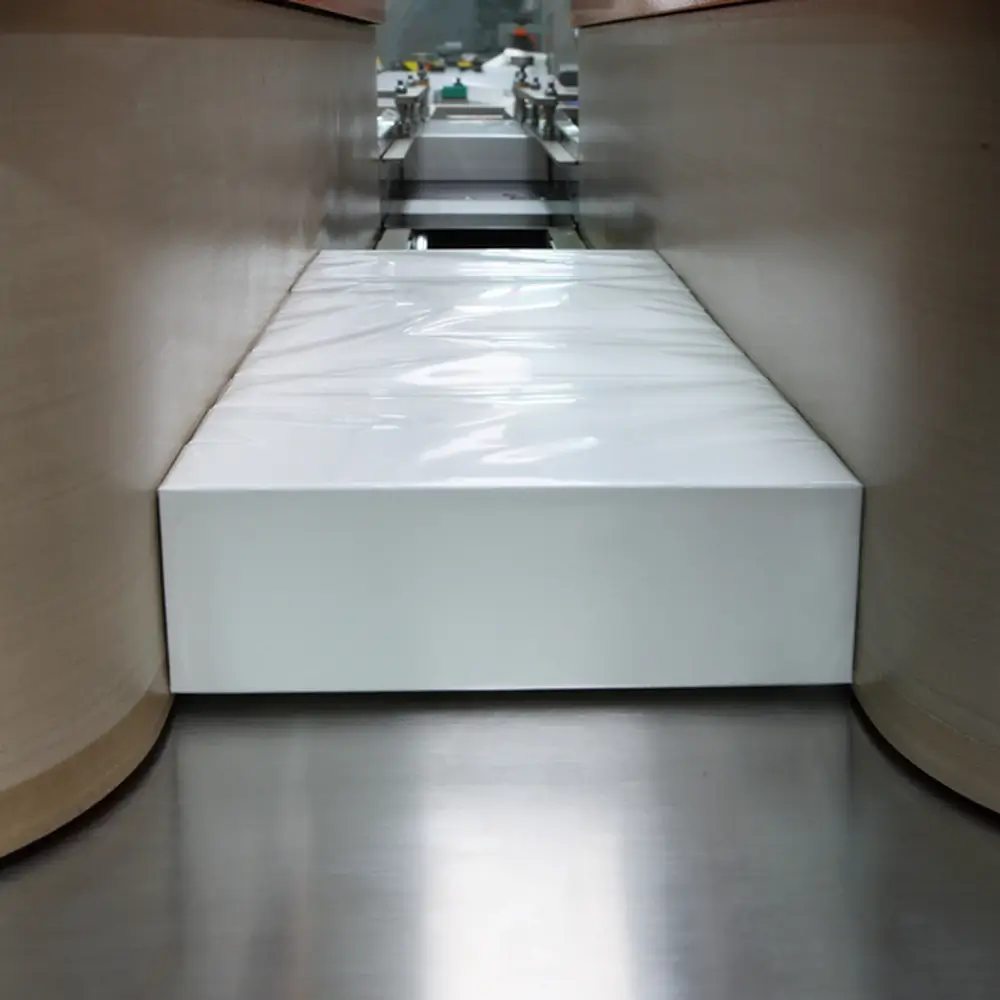
The GDST450 automatic 3D overwrapping machine folds heat-sealable film around individual cartons or stacked carton groups to create a six-sided, envelope-style wrap. Its published packaging materials are heat-sealable BOPP or PVC film. Specify the film construction and sealing requirements rather than assuming that every transparent film behaves the same way.
Swipe horizontally to view all columns.
| GDST450 item | Specification |
|---|---|
| Packaging speed | 20–60 packs/min |
| Packaging size (L × W × H) | 30–300 × 60–250 × 15–150 mm |
| Pack configuration | Individual cartons or stacked carton groups |
| Motion control | Delta motion controller; Delta servo drives and motors |
| Operator interface | Delta touchscreen HMI |
| Total power / supply | 10 kW / 380 V, 50 Hz |
| Compressed air | 0.6 MPa; 20 L/min |
| Discharge height | 890 ± 30 mm |
Wrapping speed varies with carton dimensions and stacking arrangements. Confirm the infeed orientation, transfer height, grouping method, film overlap and acceptable seal appearance. The overwrapping equipment range provides other options for comparison.
Balance Output in Finished Packs per Minute
Tube speed, carton speed and wrapped-pack speed measure different operations. First define how many tubes go into each carton and how many cartons go into each wrapped pack. Then express every stage in the same final-output unit.
Illustrative planning example: assume one filled tube per carton and one carton per wrapped pack. Using the published upper values gives 110 tubes/min for GD120-A, 100 cartons/min for GDS120 and 60 packs/min for GDST450. The smallest upper value is 60 wrapped packs/min. This calculation is a screening limit under those assumptions, not a measured or guaranteed line output.
If your requirement is 100 individually wrapped cartons per minute, these figures are a reason to reconsider the wrapping stage or overall arrangement. If several cartons form one wrapped pack, convert that group output back to cartons and tubes before comparing. Group formation and transfer must also be included in the capacity review.
Put the acceptance target in writing. State good finished packs per minute, the agreed product and packaging samples, test duration, allowable rejects, and how stops and replenishment are counted. Ask for the proposed test method with the quotation.
Example Cosmetic Tube Packaging Workflow
This UML activity diagram shows the material-dependent filling choice followed by the cartoning and optional overwrapping stages. The actual transfer systems, inspection steps and machine settings should follow the agreed product and package specification.
Select the filling and sealing path by tube material. Cartoning feed, wrapping format and acceptance checks are specified for the project.
What PLCs, Servos and Sensors Mean for the Buyer
Separate the control brand from the promised function
The GD120 specification lists a Siemens PLC and touchscreen. The GDS120 lists PLC and touchscreen control with variable-frequency speed adjustment. The GDST450 lists a Delta motion controller, servo drives, motors and touchscreen. These are different control descriptions; retain the model-specific configuration when comparing quotations.
A useful enquiry asks how an operator selects a format, adjusts permitted settings, identifies a fault and recovers from a stop. Request the specific controller and drive models where they matter for your plant standards or spare-parts planning. Do not infer a complete machine function from the component brand.
As an industry example, the Siemens SIMATIC S7-1200 G2 platform includes motion-control capabilities and diagnostic connectivity. That illustrates the functions modern controllers can support; it does not identify the PLC generation installed on GD120 or add those functions to its quoted configuration.
Specify what must be detected and what happens next
A photoelectric sensor uses an emitter and receiver to detect a change in light caused by an object. The sensing arrangement and the target surface affect detection. OMRON’s photoelectric-sensor guide explains through-beam, reflective and other sensing methods.
For the packaging project, define the detection task: tube presence, product position, film absence or finished-pack discharge. Also specify the required response, such as inhibiting a cycle, stopping or rejecting. The GDST450 lists Leuze / SICK photoelectric sensors; the OMRON reference explains the principle and is not a change to that equipment specification.
Review utilities and motion as part of the complete machine
For a servo-controlled wrapping machine, ask which movements are coordinated and which format adjustments still require mechanical work. For compressed air, confirm both the required pressure and flow, the supply conditions, air preparation and the total demand of the proposed arrangement. A pressure value alone is not a compressor-sizing specification.
Compare Quotation Scope, Not Only Machine Price
A meaningful cosmetic packaging machine price is tied to a defined product, package and supply scope. Start by asking suppliers to quote against the same requirement sheet. This makes differences in feeding, tooling, utilities and service visible before the order.
Swipe horizontally to view all columns.
| Quotation item | What to ask the supplier to state |
|---|---|
| Base machine and configuration | Exact model, sealing method, control components and included functions |
| Formats and change parts | Tube sizes, cartons, wrapped groups and the tooling supplied for each |
| Feeding and line interfaces | Feeder arrangement, conveyors, transfer heights and responsibility for coordination |
| Options | Leaflet handling, glue closing, coding and inspection functions that are included |
| Sample trials and acceptance | Samples, output definition, quality criteria, test duration and documentation |
| Utilities and installation | Complete load schedule, air demand, footprint, access and connection requirements |
| Service and spare parts | Training, commissioning, support scope, spare parts and agreed warranty terms |
| Delivery scope | Packing, delivery basis, transport responsibilities, lead time and payment terms |
For ongoing costs, compare film and carton consumption, format-change work, cleaning access, routine consumables, spare-part availability and the labour needed to keep the equipment supplied. Ask for evidence behind any claimed saving. A lower base price may simply cover a smaller delivery scope.
Why Consider GRAND Machinery Technology?
GRAND Machinery Technology is the brand of WENZHOU GRAND MACHINERY TECHNOLOGY CO., LTD., a machinery manufacturer and exporter with its own factory in Wenzhou, China. The company combines equipment manufacturing, sales and export support, with a range covering mixing, tube filling and sealing, cartoning, overwrapping and downstream packaging.
For a tube-and-carton project, this range provides a starting point for discussing several process stages with one team. The useful next step is a configuration and scope review using your actual package, followed by a quotation that states equipment, options, interfaces and service responsibilities. Learn more about GRAND Machinery Technology.
Ask the team to review your primary format first, then list the additional formats you expect to run. This helps distinguish what the initial machine and tooling must do from options you may want later.
Prepare Your Cosmetic Packaging Enquiry
Swipe horizontally to view all columns.
| Information to provide | Useful details |
|---|---|
| Product | Cream, gel or paste; viscosity with measurement temperature; filling temperature |
| Tube | Plastic, laminate or aluminum; dimensions, cap, tail and drawings or samples |
| Fill quantity | Target in g or mL, required tolerance and any product-density information |
| Carton | Internal and external dimensions, board specification, leaflet and closure type |
| Overwrap | Single carton or group, pack orientation, film specification and desired finish |
| Output | Good finished packs/min, tubes/carton, cartons/pack and shift requirements |
| Site | Installation country, voltage/frequency, air supply, floor plan and existing equipment |
Start with the information you have and identify which packaging formats are already fixed. The remaining details can be resolved during the equipment discussion. Send your project requirements through the enquiry form or contact the GRAND team.
Frequently Asked Questions
Which cosmetic packaging machine should I choose for cream tubes?
Start with the tube material and filling requirement. GD120-A is the hot-air-sealing configuration for plastic and laminated tubes; GD120-Z uses mechanical folding for aluminum tubes. Compare the relevant tube size and fill range, then evaluate the product and packaging samples.
Can GD120-A and GD120-Z use the same filling specification?
Their published filling ranges use different units: 3–250 g for GD120-A and 3–180 mL for GD120-Z. Do not substitute one for the other. GD120-A’s ±1% accuracy statement applies to fills of 30 g or above; obtain an application-specific accuracy specification for GD120-Z.
Can every tube accepted by GD120 be cartoned on GDS120?
No. The filling-machine tube range and cartoner carton range describe separate machines. Check the finished tube, internal carton clearance, leaflet, insertion direction and feeding arrangement together. Long tubes or a different pack format may require another cartoning configuration.
Does 3D overwrapping mean shrink wrapping?
GDST450 forms a six-sided envelope-style wrap by folding and heat-sealing film around the carton or carton group. Specify this wrapping method when comparing equipment; do not treat a shrink-wrapping process as the same machine configuration.
Can these machines deliver 100 finished wrapped cartons per minute?
That cannot be concluded from the individual specifications. With one tube per carton and one carton per wrapped pack, the GDST450’s published upper rate is 60 packs/min. Final output needs a complete configuration review and agreed acceptance test using the actual package.
How do I obtain a useful quotation?
Send the product, tube material and dimensions, target fill quantity, carton and film requirements, finished output and installation country. Ask for a quotation with a clear base configuration, options, format tooling, interfaces and service scope.
Ready to compare a configuration for your product? Request a Cosmetic Packaging Machine Quote and tell us what you need to fill, carton and wrap.


Sales Manager