
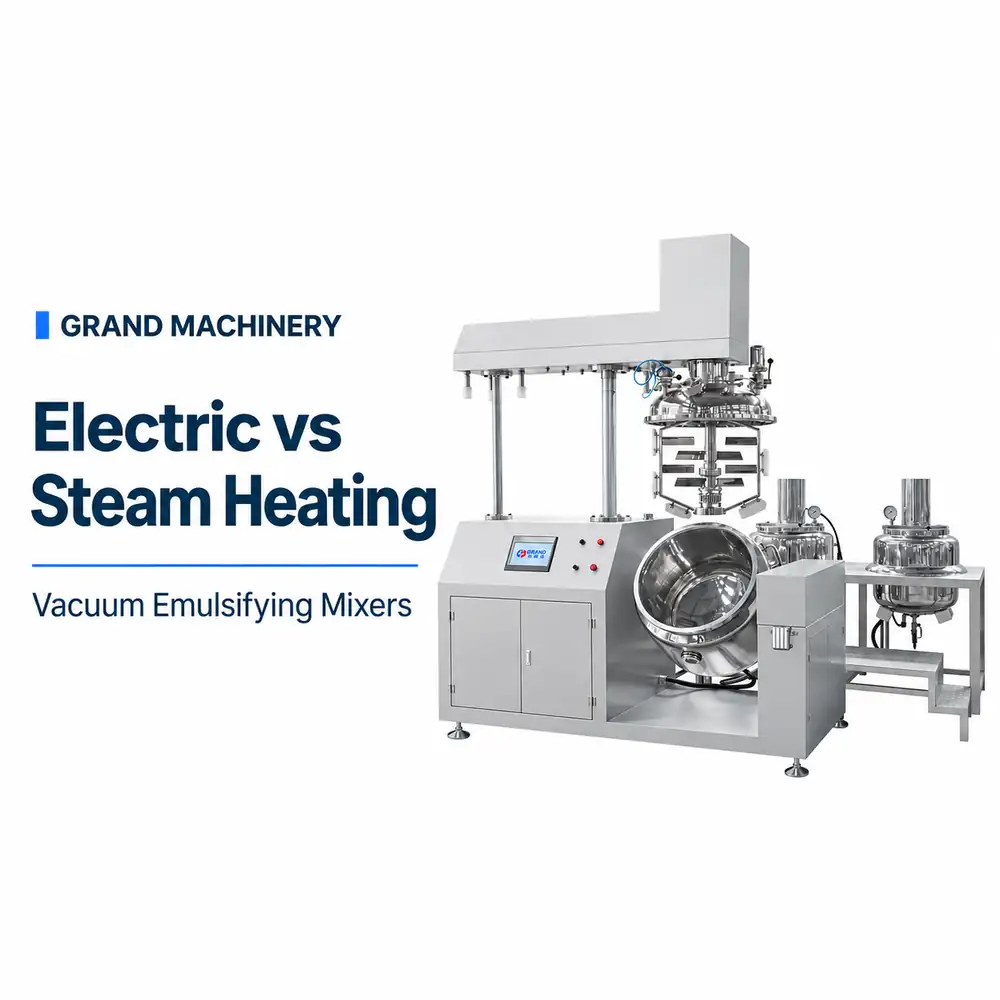
Heating is easy to overlook when specifying a vacuum emulsifying mixer. Yet the way a vessel receives heat affects the utilities a factory needs, how a batch responds to temperature changes, and the work required to maintain the system.
For manufacturers making creams, lotions, ointments, and other emulsified products, the practical comparison is often electric heating vs steam heating in a jacketed mixing vessel. Both can heat ingredients indirectly, without placing a heater or steam directly in contact with the product. Neither is automatically the faster or more economical choice for every factory.
The short answer: Electric heating often makes sense when a plant has suitable electrical capacity but no existing steam infrastructure. Steam heating deserves closer evaluation when the factory already operates a reliable steam system or needs to distribute heat among several vessels. The better choice depends on the formulation, batch size, jacket design, temperature profile, available utilities, and total operating cost.
How Heating Works in a Vacuum Emulsifying Mixer
A typical vacuum emulsifying mixer combines mixing, homogenization, vacuum operation, and temperature management. The mixing tools disperse ingredients, while the heating or cooling system supports the temperature steps required by the formulation.
For many configurations, the main vessel has a jacket: a space or heating assembly outside the product-contact wall. Thermal energy passes through that wall into the batch. Product-side agitation helps renew the material next to the warm surface and distribute heat through the vessel.
This distinction matters. The heating medium is generally separate from the formulation in an indirect jacketed design. The fact that a mixer uses steam does not mean steam is injected into the cream or lotion; the actual heating circuit must be confirmed on the equipment drawing.
Heating performance is influenced by several interacting factors:
- Heat-transfer area: How much jacketed wall is available to transfer heat.
- Temperature difference: The difference between the heating side and the product.
- Formulation properties: Viscosity, heat capacity, and changes in consistency during the batch.
- Agitation: How effectively the mixer circulates product near the wall.
- Insulation and losses: How much energy escapes through the vessel and utility network.
- Control strategy: Where temperatures are measured and how heat input is modulated.
In other words, comparing two mixing tanks by their stated heater power or steam connection alone will not predict the complete batch heating time.
How Heat Reaches the Product
Both methods transfer heat indirectly across the vessel wall. The route supplying the jacket is different.
Electric jacket heating
- Facility electricity
- Electric heating circuit
- Vessel jacket
- Product in vessel
Steam jacket heating
- Plant steam supply
- Steam control valve
- Vessel jacket
- Product in vessel
Condensate is removed from the jacket and, where designed, returned to the steam system.
Conceptual comparison only. Confirm the heating circuit, temperature controls and utility connections for the specific mixer.
Electric Heating: How It Works and Where It Fits
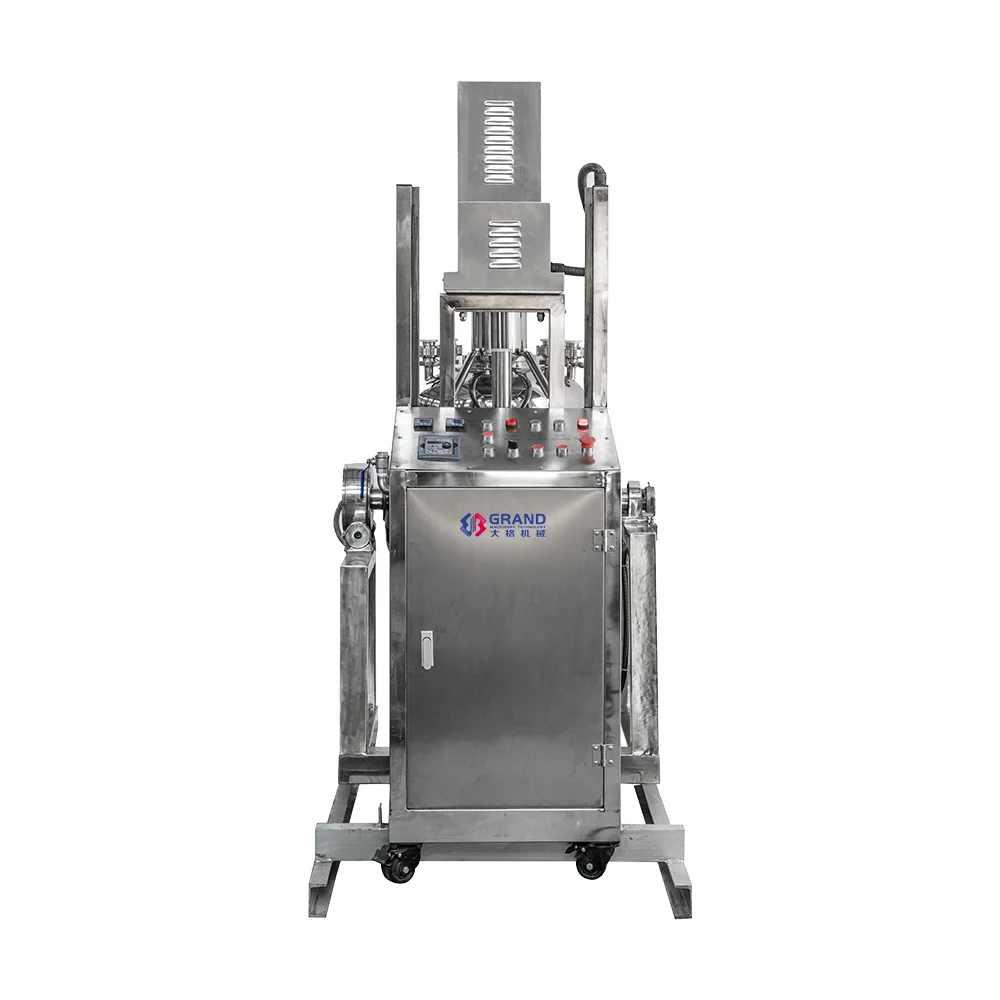
In an electrically heated jacketed mixing tank, electrical energy supplies the process heat. Depending on the machine design, resistance heaters may heat a jacket medium, a circulation loop, or another indirect heating assembly. The resulting heat transfers through the vessel wall to the product.
The exact arrangement is important: an electric heating mixing tank does not necessarily use the same jacket liquid or control hardware as another manufacturer’s electric model. Ask for the heating-circuit drawing and heater specification rather than assuming a particular medium.
Electric heating can be attractive for independent production lines, smaller installations, and facilities that do not already operate a steam network.
Potential advantages
- Fewer plant-wide steam dependencies: A properly designed electric system can operate without a central steam boiler or condensate-return network.
- Straightforward utility planning: The main external requirement is an electrical supply appropriate for the installed heaters, motors, and controls.
- Flexible control: Electric power can be regulated to follow a specified temperature profile, subject to heater design, sensor placement, and controller tuning.
- Useful for smaller or standalone installations: A dedicated heating package may be easier to integrate when only one process vessel requires heat.
Points to check
- Available electrical power, voltage, phase, protection, and peak demand.
- Whether the heating medium and jacket design meet the formulation’s required temperature range.
- Heater access, circulation requirements, temperature sensors, and over-temperature protection.
- Total heating time at the intended working volume, not merely the empty-vessel or water-test result.
Electric heating is not automatically cheaper to run. Local electricity tariffs, demand charges, insulation, operating hours, and thermal losses can change the outcome substantially.
Steam Heating: How a Steam Jacketed Tank Works
In a steam jacketed tank, steam enters the jacket space or a designated indirect heat-transfer circuit. As it gives up heat and condenses, thermal energy passes through the vessel wall into the batch. The condensate then needs an appropriate removal or return path.
This is a well-established form of indirect industrial heating. Spirax Sarco’s engineering guide to heating with coils and jackets explains the role of the jacket wall, steam condensation, heat-transfer surface, and condensate drainage.
Steam can be a strong option for a facility already distributing suitable process steam to several production lines. It can deliver substantial heat through a properly sized jacket, but practical results depend on the steam conditions, control valve, available heat-transfer area, and condensate management.
Potential advantages
- Integration with shared utilities: An existing plant steam system may supply several vessels from one utility infrastructure.
- Effective indirect heat transfer: Condensing steam can transfer heat efficiently at the jacket surface when the system is correctly designed and drained.
- Scalability across process equipment: Steam may suit facilities with multiple heating duties beyond one emulsifying vessel.
Points to check
- Steam availability at the actual required pressure, temperature, quality, and flow rate.
- The vessel jacket’s allowable operating conditions and compatible controls.
- Steam isolation, pressure regulation, air removal, trapping, condensate discharge, and return arrangements.
- Boiler or steam-purchase costs, water treatment, distribution losses, and maintenance responsibility.
A steam-heated vessel requires more than an inlet connection. Inadequate condensate removal or poorly matched pressure controls can undermine heating performance and operational reliability.
Electric vs Steam Heating: Side-by-Side Comparison
| Decision factor | Electric jacket heating | Steam jacket heating |
|---|---|---|
| Heat source at the vessel | Electrically powered heaters or an electric heating circuit | Steam supplied to an indirect jacket or heating circuit |
| Main utility requirement | Adequate electrical supply | Suitable steam supply plus condensate management |
| Installation considerations | Electrical distribution, protection, heating circuit, and controls | Steam piping, controls, pressure protection, drainage, and often return piping |
| Heating response | Depends on installed duty, thermal mass, jacket design, and control | Depends on steam conditions, valve capacity, condensation, drainage, and jacket design |
| Temperature control | Regulated electrical input and process sensors | Steam-flow/pressure regulation and process sensors |
| Routine maintenance | Electrical heaters, sensors, connections, and any circulating medium | Valves, traps, strainers, steam/condensate piping, and the wider utility system |
| Cost drivers | Electricity tariff, peak demand, heat losses, and operating hours | Steam generation or purchase, distribution losses, treatment, condensate recovery, and operating hours |
| Often worth considering when | The line is standalone or no suitable steam service exists | A reliable steam network already supports multiple process vessels |
This comparison describes system-level trade-offs, not a guarantee that one heating method will outperform the other on a specific mixer.
Which Method Heats a Batch Faster?
There is no defensible universal answer. Steam systems can provide substantial heat-transfer capacity, but a high-output electric jacket may outperform an undersized or poorly drained steam installation. Conversely, a steam jacket with sufficient surface area and correctly managed condensate may be effective for a demanding heating duty.
To compare proposals fairly, ask both suppliers to evaluate the same process conditions:
- Product mass or working batch volume.
- Starting temperature and target temperature.
- Representative viscosity and specific heat, if available.
- Time allowed to reach the target temperature.
- Jacket area, heating-medium conditions, and heating duty.
- Mixer operating conditions during heat-up.
The supplier should then explain the basis of the estimated heat-up time, including assumptions and any relevant test evidence. A nominal heater rating alone is not a batch-performance guarantee.
Which Method Costs Less to Operate?
The fairest comparison is the cost of useful heat delivered to the batch, not the price of electricity versus fuel in isolation.
As an initial engineering estimate, the energy needed to raise a product’s temperature can be represented by:
Q ≈ m × cp × (Ttarget − Tstart)
Here, m is product mass, cp is its approximate specific heat, and the temperature difference is the required rise. This estimates the product’s sensible heating requirement; it does not include vessel heat-up, ambient losses, evaporation, or other process effects.
For an electric system, assess the metered electricity required at the proposed operating conditions, any demand charges, and the supporting equipment. For steam, assess the cost of steam delivered to the jacket, including generation or purchase, distribution, condensate recovery, and water-treatment losses. Shared infrastructure costs should be allocated consistently.
The U.S. Department of Energy’s overview of process heating systems distinguishes steam-based and electricity-based industrial heating, including the fact that steam itself may be produced in an electric boiler. This is why steam and electricity are not always competing primary energy sources: steam describes the heat-transfer medium at the vessel, while electricity describes an energy input.
If one supplier claims a fixed percentage of savings, request the calculations, utility rates, production schedule, and measurement conditions behind that number.
How the Heating Choice Affects Emulsion Quality
For creams, lotions, and ointments, the process temperature often influences ingredient melting, viscosity, and the conditions under which phases are combined. Reaching a target temperature is only part of the challenge; maintaining a repeatable temperature profile matters as well.
Neither electric nor steam heating guarantees a stable emulsion by itself. The result also depends on formulation chemistry, phase preparation, homogenization, scraping/agitation, temperature measurement, and the cooling sequence.
Pay particular attention to:
- Wall-to-bulk temperature difference. Product near the warm wall may experience different conditions from the material around the temperature probe.
- High-viscosity stages. Heat transfer can change as the batch thickens; suitable wall scraping and agitation may be important.
- Heat-sensitive ingredients. Heating limits and addition temperatures should come from the validated formulation, not from the mixer brochure alone.
- Cooling transition. Confirm whether the same vessel jacket supports water cooling and how the process switches from heating to cooling.
For a fuller explanation of the mixing stages, see GRAND’s guide to the working principle of a vacuum emulsifying mixer. This article focuses specifically on the heating-side decision.
Choosing a Heating Method for Your Production Line
If you operate a small, independent batch line
Start by checking the available electrical service, batch heat load, and whether installing a steam utility would be justified for a single vessel. An electric configuration may be practical when the required heating performance can be achieved within those electrical limits.
If your facility already has a steam network
Evaluate steam-jacket compatibility before installing another heat source. Verify the available steam at the connection point, permissible jacket conditions, condensate return, and whether the utility has sufficient capacity during simultaneous production.
If you produce several formulations on the same mixer
Ask for heating and cooling profiles for the most demanding representative recipe, not just a low-viscosity demonstration. Products that need different temperature ramps may place very different demands on the heating controls.
If you plan to scale up batch size
Check how the larger vessel’s heat-transfer area compares with product mass and mixing duty. Larger batches do not necessarily heat in the same time simply because the utility input increases. Review future boiler or electrical distribution capacity as part of the scale-up assessment.
GRAND Vacuum Emulsifying Mixer Configurations
GRAND’s published product range illustrates why the heating choice should be checked model by model.
The CB50 50L vacuum emulsifying mixer (lift-type) is listed with 50 L working capacity, a 70 L main vessel, electric heating, and tap-water cooling. It is a useful reference point for discussing an electric-heated configuration. Those figures describe the published CB50 listing, not an assumed performance guarantee for every batch.
The CB150 150L vacuum emulsifying mixer is listed with 150 L working capacity, a 220 L main vessel, and a choice of electric or steam heating, with water cooling. This makes it a relevant model for reviewing the utility trade-offs described above. The final heating arrangement and applicable technical data must be confirmed for the project configuration.
These examples should not be generalized to other GRAND models without reviewing their own product specifications. In particular, a heating option mentioned for one model is not proof that every model ships with the same equipment.
What to Confirm Before Finalizing the Heating Configuration
To turn a general comparison into a reliable equipment specification, give the engineering team the following information:
- Intended product type, formulation characteristics, and temperature-sensitive processing steps.
- Minimum, normal, and maximum working batch sizes.
- Initial and target temperatures, required heat-up time, and holding duration.
- Factory electrical service and/or steam conditions at the proposed installation point.
- Available cooling-water conditions and required cool-down steps.
- Cleaning expectations, operating schedule, and any site-specific safety or hygienic requirements.
Request a heating-circuit diagram, utility schedule, control description, and clearly stated heat-up assumptions for the proposed machine. They are more useful than comparing an isolated headline specification.
Frequently Asked Questions
It can be a practical choice for smaller standalone systems because it does not inherently require a plant steam network. However, the decision still depends on the heat load, power availability, desired temperature range, and machine configuration.
No. A steam-heated vessel needs a suitable steam supply, but that supply may come from an existing centralized system or another approved plant arrangement. Steam distribution and condensate management must still be designed for the installation.
No. Heat-up time depends on the heat delivered through the jacket, the product properties, agitation, heat losses, and the control system. Compare supplier calculations or test results under the same batch conditions.
Some electrically heated models have a separate or switchable water-cooling function. For example, GRAND lists electric heating and tap-water cooling for its CB50. Confirm the relevant heating/cooling circuit and switching procedure on the proposed model.
Not in a correctly designed indirect steam-jacket system: the steam is on the utility side of the vessel wall. Direct steam injection is a different heating arrangement and should never be assumed from the term “steam heating.”
First check your factory’s usable utilities and the actual formulation heating duty. GRAND lists electric and steam heating as configuration options for its CB150, so the final choice should follow a project-specific utility and process review.
Match the Heating System to the Process, Not Just the Tank Size
Electric heating and steam heating can both serve a vacuum emulsifying mixer effectively when the jacket, utilities, controls, and operating procedure suit the product. Electric heating may simplify a standalone line; steam may fit naturally into a plant with established steam utilities. Neither label alone predicts heating speed, operating cost, or emulsion quality.
If you are evaluating a heated mixing tank for a new or expanding production line, share your batch size, temperature profile, formulation type, and available utilities with the GRAND Machinery team. They can review the relevant mixer configuration and identify which heating details need confirmation for your process.


Sales Manager
 English
 Spanish
 French
 Russian