

A cream can look uniform in the mixer and separate after cooling or filling. Check the formulation, droplet structure and processing history before treating higher mixer speed as the solution.
An emulsification mixer helps form and process an emulsion, while lasting physical stability also depends on ingredient compatibility, circulation, temperature history and downstream handling. This guide focuses on emulsion-based cosmetic creams and lotions and gives a framework for planning an investigation.
Quick Troubleshooting Guide
Record the visible change and when it first appeared. Use comparable retained samples and batch records to choose the next check:
- Layers, oiling out or watery release: identify the separation mechanism, then review formulation and storage history.
- Graininess that appears during cooling: compare phase preparation and the temperature–time history.
- Foam or bubbles: trace air entry and the deaeration stage separately from oil–water stability.
- Different results across the vessel: check circulation, ingredient incorporation and sampling consistency.
Choose a hypothesis before changing settings. Define the comparison sample, sampling method and acceptance criteria; then follow the product through cooling, transfer, filling and storage.
Identify the Defect Before Naming the Cause
In an oil-in-water emulsion, oil droplets sit within a continuous water phase; water-in-oil emulsions reverse those roles. A visible layer can develop through different mechanisms.
Swipe horizontally to view all columns.
| Change | What happens | Useful distinction |
|---|---|---|
| Creaming or sedimentation | Droplets migrate upward or downward, creating a concentration difference. | Movement does not necessarily mean the droplets have fused. |
| Flocculation | Droplets form clusters while retaining individual boundaries. | A cluster is different from one larger droplet. |
| Coalescence | Separate droplets merge into larger ones. | This changes droplet structure, rather than merely redistributing droplets. |
| Serum release or apparent “weeping” | Liquid becomes visibly separated from the structured product. | Appearance alone cannot distinguish network changes from other separation mechanisms. |
An oily-looking top layer is therefore an observation, not a complete diagnosis. Microscopy and appropriately measured droplet-size distributions can help distinguish concentrated droplets, clusters and droplet growth.
Other defects need separate consideration. Graininess may involve undispersed powder or crystallized material. Foam contains gas bubbles, not just liquid droplets. Ostwald ripening—growth involving molecular transfer between droplets—and phase inversion are additional possibilities in suitable systems, but neither should be diagnosed from a surface photograph.
These mechanisms can also coexist. A batch can contain air while its emulsion structure changes. Classifying one defect should not automatically close the investigation into another.
Review Formulation and the Continuous Phase
Making droplets and protecting droplets are different jobs
Breaking a larger droplet into smaller droplets creates more oil–water interfacial area. A suitable emulsifier system must stabilize that interface while the surrounding formulation supports the intended product structure.
This explains why “finer” does not automatically mean “stable.” Small droplets with inadequate interfacial protection can still change after processing. Conversely, a thick-looking cream can conceal changes in its droplet population.
For troubleshooting, review the complete formulation rather than only the emulsifier percentage. Oil composition, dispersed-phase fraction, emulsifier combinations and thickener compatibility can all change the system being processed. An ingredient substitution may preserve the label description while changing the material’s actual behavior.
The continuous phase also matters
Many creams obtain their texture from more than dispersed droplets. Polymers and structures involving surfactants, fatty alcohols or wax components may contribute to their rheology—the way they flow and recover after deformation.
A practical distinction follows: loss of viscosity and droplet coalescence are not interchangeable findings. Measure texture-related changes and droplet-related changes separately, then consider whether they are connected.
Water quality and dissolved ingredients deserve attention too. Research on two non-ionic alkyl polyglucoside emulsifier systems found that changing the water’s ionic composition altered viscosity and viscoelastic behavior. The result was formulation-dependent; it does not mean that every electrolyte destabilizes every cream.[1]
Check pH against the approved formulation and compare measurements made under the same method and temperature. For systems containing ionizable ingredients, a pH change may alter interactions or thickening behavior. There is no single corrective pH suitable for all cosmetic emulsions.
Separate the Functions of an Emulsification Mixer
An integrated machine may perform several operations, but those operations solve different problems.
Swipe horizontally to view all columns.
| Function | Main contribution | What it does not establish |
|---|---|---|
| High-shear homogenization | Local deformation, dispersion and droplet breakup under suitable conditions | Long-term stability by itself |
| Bulk agitation | Movement of material through the vessel and distribution of additions | Identical treatment at every location without process verification |
| Heating and cooling | Control of the thermal stages required by the formulation | One temperature profile suitable for all creams |
| Vacuum processing | Removal of entrained air under suitable operating conditions | Correction of an incompatible emulsifier system |
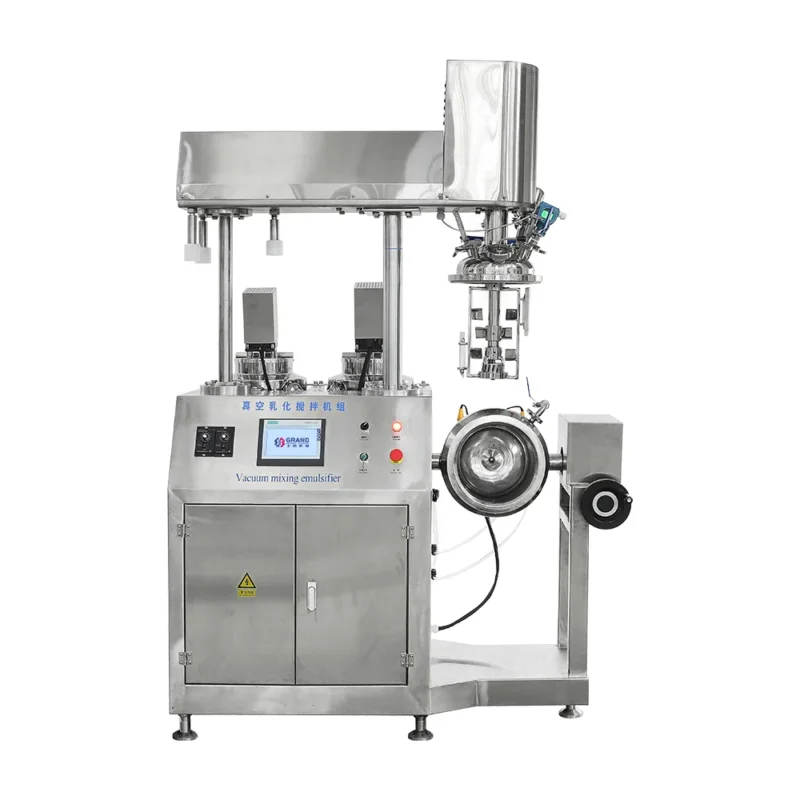
For an equipment example, GRAND’s CB100 vacuum emulsifying mixer lists a 100 L working capacity and a 160 L main vessel, together with separate homogenizing and slow-agitation functions, vacuum mixing, and heating and cooling.
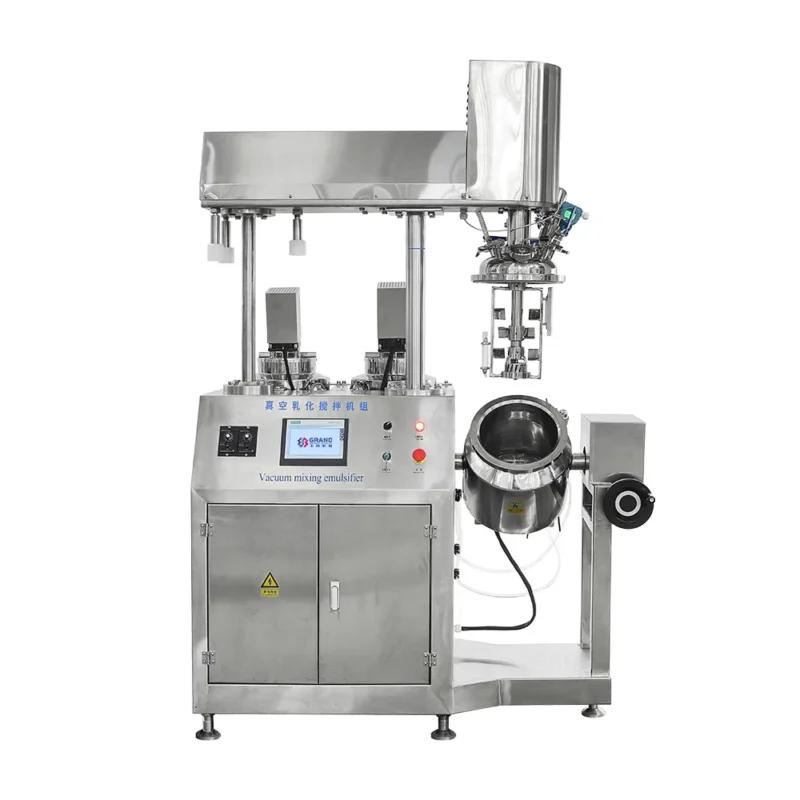
The broader emulsifying mixer range provides equipment context. A troubleshooting investigation still needs the actual formulation, batch history and configuration of the machine in use.
Check High Shear and Whole-Batch Circulation
In a rotor–stator mixer, material is exposed to intense local deformation around a rotating element and a stationary workhead. Silverson’s technical explanation describes how material is drawn into the workhead, sheared and recirculated through the vessel.[5]
Local processing and vessel-wide circulation are related but different. A powerful workhead cannot demonstrate that every part of a viscous batch has received equivalent treatment.
Calvo and colleagues studied cosmetic emulsions at different dispersed-phase concentrations and examined both impeller tip velocity and pumping capacity. Their findings support considering droplet deformation and circulation together, rather than treating rotational speed as the only relevant variable.[2]
For example, if samples from approved vessel sampling points differ, investigate circulation, incorporation of additions and sampling consistency before assuming that the entire batch needs more shear. If samples agree initially but change during storage, the investigation must extend beyond immediate uniformity.
The same reasoning applies when scaling up. Matching rpm does not match rotor dimensions, vessel geometry, material flow or cooling history. A larger batch needs a demonstrated process transfer, not simply the smaller batch’s settings copied onto a different machine.
Review Heating, Ingredient Addition and Cooling
Before and during emulsification
The state of each phase matters when the phases meet. Where the approved process requires melted waxes, hydrated polymers or dissolved ingredients, incomplete preparation introduces a different starting material into the emulsification stage.
Record the actual product temperatures, not only jacket settings. Also compare the order, location and timing of additions. A late ingredient addition can change composition locally before it has dispersed through the batch.
Do not interpret every visible particle as an oil droplet. A powder agglomerate calls for a different investigation from droplet coalescence.
During cooling
Some cream structures continue developing after the principal emulsification step. Cooling can change the organization of wax and fatty-alcohol components, while agitation acts on a product whose consistency is also changing.
In a 2024 study of a particular emulsion cream, introducing a holding stage during cooling improved stability under the tested conditions. Additional shear during that stage affected the developing structure, and the result depended on the temperature at which it was applied.[3]
That study does not establish a universal cooling temperature or prove that agitation during cooling is always harmful. Its practical significance is that the post-emulsification stage can deserve as much investigation as the initial homogenization stage.
Compare the complete temperature–time history of acceptable and affected batches. “Both finished at the same temperature” is incomplete: one batch may have cooled steadily while another experienced a long hold or a different mixing schedule.
Where graininess appears only after cooling, retain samples from before and after the change. That timing helps focus the investigation on what developed during cooling, without prematurely deciding which ingredient or mechanism caused it.
Treat Vacuum Deaeration as an Air-Control Step
Vacuum can assist with removing entrained air. IKA’s 2023 cosmetic-formulation brochure describes a laboratory reactor system combining heating, cooling, mixing, dispersing and vacuum control, and specifically lists vacuum for de-foaming during mixing.[4]
The distinction matters because a gas bubble and an oil droplet are different dispersed structures. A product can become less foamy without its oil–water interface becoming more stable.
If the dominant defect is bubbles, investigate when air entered: ingredient addition, surface agitation, transfer or filling. Review the timing of the vacuum stage and the condition of the system through your facility’s approved operating and maintenance procedures.
Compare observations before and after deaeration using consistent methods. Improvement in visible bubbles supports an air-related explanation for that defect; it does not prove that all other quality attributes have improved.
If a distinct oil or water layer remains after the bubble problem is addressed, return to the emulsion investigation. “More vacuum” is not a substitute for identifying the remaining mechanism.
Build a Testable Investigation
Start with one clear problem statement: for example, “A visible upper layer appeared after cooling, but was absent in the sample collected immediately after emulsification.”
Then separate observations, hypotheses and the evidence needed to distinguish them.
Swipe horizontally to view all columns.
| Observation | Questions to investigate | Evidence that helps |
|---|---|---|
| A concentrated layer appears, but droplets may remain separate | Is migration or flocculation occurring, rather than fusion? | Comparable top and bottom samples, suitable microscopy and time-dependent droplet observations |
| Larger droplets appear after storage | Has the droplet population changed, and by which mechanism? | Initial and stored size distributions, microscopy and a review of formulation and storage history |
| Graininess develops during cooling | Are the particles crystals, agglomerates or another structure? | Samples across cooling stages, microscopy appropriate to the material and phase-preparation records |
| Samples differ across the vessel | Is circulation, ingredient incorporation or sampling responsible? | Defined sampling locations and times, addition records and repeat sampling under an approved procedure |
| Bubbles appear mainly after transfer or filling | Is air being introduced downstream of the vessel? | Matched samples before transfer, after transfer and after filling |
| Only some filled packs change | Do package, filling or storage differences correlate with the defect? | Bulk retains and filled-pack retains, container records and storage-temperature history |
The table is a set of investigation prompts, not a diagnosis or proof that one condition has a single cause.
A useful controlled trial states four things in advance: the hypothesis, the change being tested, the comparison sample and the acceptance criteria. Avoid changing formulation, shear, cooling and vacuum simultaneously without an experimental design; otherwise an improved result may still leave the cause unknown.
An initial screening trial may isolate one factor. Where interactions are likely, a structured experimental design is more informative than repeatedly adjusting settings by intuition.
Investigation workflow
- 1. Record the defect and retain samples
Describe what changed and when it first appeared.
- 2. Assess the dominant evidenceBubbles
Review air entry and deaeration.
Layers or texture changesReview formulation and process history.
If defects coexist, investigate both paths.
- 3. Define a hypothesis and controlled trial
Set the comparison, sampling method and acceptance criteria.
- 4. Compare matched samples over time
Follow the product through cooling, transfer, filling and storage.
- 5. Are the acceptance criteria met?Yes
Document the findings for quality review.
No or unclearRevise the hypothesis and return to step 2.
Follow your facility’s product-specific quality review and batch-release procedures when assessing the findings.
Assess Stability After Cooling, Filling and Storage
An improvement at discharge is a useful observation, but it is not the end of the assessment.
Compare samples using the same preparation and measurement methods. Record temperature and sample age when measuring viscosity. For droplet measurements, use suitable sample preparation: changes introduced by dilution or handling can otherwise complicate interpretation.
Track the relevant properties over time rather than relying on one average value. A mean droplet size can conceal a changing coarse-droplet population, while a single viscosity measurement cannot describe every aspect of flow behavior.
Include the intended finished package and relevant storage conditions in the assessment. ANVISA’s cosmetic stability guide treats formulation stability, packaging compatibility and distribution conditions as related but distinct considerations.[6]
Accelerated or stress testing should answer a defined question. A screening result does not, by itself, establish shelf life; excessively severe conditions may introduce changes unlike those expected during normal distribution. Physical appearance also does not replace the necessary chemical or microbiological evaluations.[6]
Finally, keep troubleshooting and batch disposition separate. A sample that looks uniform after remixing does not establish that the affected production batch is acceptable. Rework and release remain subject to your facility’s quality procedures and product-specific evidence.
Frequently Asked Questions
Does a higher homogenizer speed prevent separation?
Not necessarily. Speed influences processing, but formulation, circulation and the stage at which shear is applied also matter. A setting change should test a defined hypothesis rather than serve as a universal remedy.
Can a cream separate even when its droplets are initially small?
Yes. Initial droplet size is only one observation. Interfacial stability, the surrounding structure and subsequent processing or storage can still affect the product.
Is every visible layer a sign of coalescence?
No. Droplets can redistribute without merging, and liquid release can have other explanations. Use observations and measurements capable of distinguishing the suspected mechanisms.
Can a vacuum emulsification mixer guarantee shelf life?
No. Vacuum is a processing capability. Shelf-life conclusions require product-specific evidence across appropriate conditions and time.
Should a separated cream simply be mixed again?
Not as an automatic corrective action. Remixing may change its appearance while leaving the cause unresolved. Any rework needs an approved method and quality assessment.
Key Takeaway
Successful emulsification mixer troubleshooting connects formulation, droplet formation, whole-batch circulation, thermal history and downstream handling.
Identify the visible defect first. Use evidence to distinguish competing explanations. Test a controlled change, then assess whether the improvement remains meaningful after cooling, filling and storage.
Prepare an Emulsification Equipment Enquiry
If your investigation identifies a need to review mixing capacity, circulation, temperature control or deaeration, prepare these details before comparing equipment:
- Product type, target batch size and viscosity range at the relevant processing temperatures
- Current vessel, homogenizer and agitation arrangement, including the normal operating fill level
- The stage at which the defect appears, with photos and comparable sample observations
- Ingredient-addition sequence, mixing stages and heating/cooling records
- Transfer and filling arrangements, available utilities and the intended equipment scope
Discuss your emulsification equipment requirements with GRAND. For selection criteria, see the emulsification mixer buying guide; for downstream tube filling and cartoning, see the cosmetic packaging equipment guide.
Technical References
- Milanković et al. (2026; first published online in 2025). Not Just Water: Ionic Influence on the Rheology of Natural O/W Emulsions. Journal of Chemical Technology & Biotechnology, 101, 578–589. First published online 14 December 2025. DOI: 10.1002/jctb.70118. Formulation-specific experimental evidence.
- Calvo et al. (2022). Effect of emulsification parameters on the rheology, texture, and physical stability of cosmetic emulsions: A multiscale approach. Chemical Engineering Research and Design, 186, 407–415. Evidence concerning processing and scale-up variables. DOI: 10.1016/j.cherd.2022.08.011.
- Chow et al. (2024). The Effect of Process Parameters on the Microstructure, Stability, and Sensorial Properties of an Emulsion Cream Formulation. Pharmaceutics, 16(6), 773. A specific cream study, not a universal operating recipe.
- IKA (2023). Lab Essentials for Your Cosmetic Formulation. Manufacturer brochure describing IKA’s laboratory reactor functions, including vacuum de-foaming during mixing.
- Silverson. High Shear Batch Mixers: How It Works. Manufacturer explanation of rotor–stator workhead stages and batch circulation.
- ANVISA (2005, English edition). Cosmetic Products Stability Guide. Background guidance on stability assessment, packaging compatibility and storage conditions.


Sales Manager
 English
 Spanish
 French
 Russian