

Buying a homogenizer mixer for 500 L production batches starts with matching the vessel, agitation, homogenization and vacuum system to your formulation.
The GRAND CB500 500L Vacuum Emulsifying Mixer is a candidate for compatible creams, pastes and other viscous formulations. Its published configuration combines a 500 L main-vessel working volume, frame agitation, high-shear homogenization, oil-phase pretreatment and a water-ring vacuum system.
This guide helps procurement and production teams assess the CB500, define the required supply scope and prepare a quotation with measurable acceptance criteria.
Considering 500 L batches? Send GRAND your product type, normal batch volume and installation country to request a CB500 configuration review and quotation.
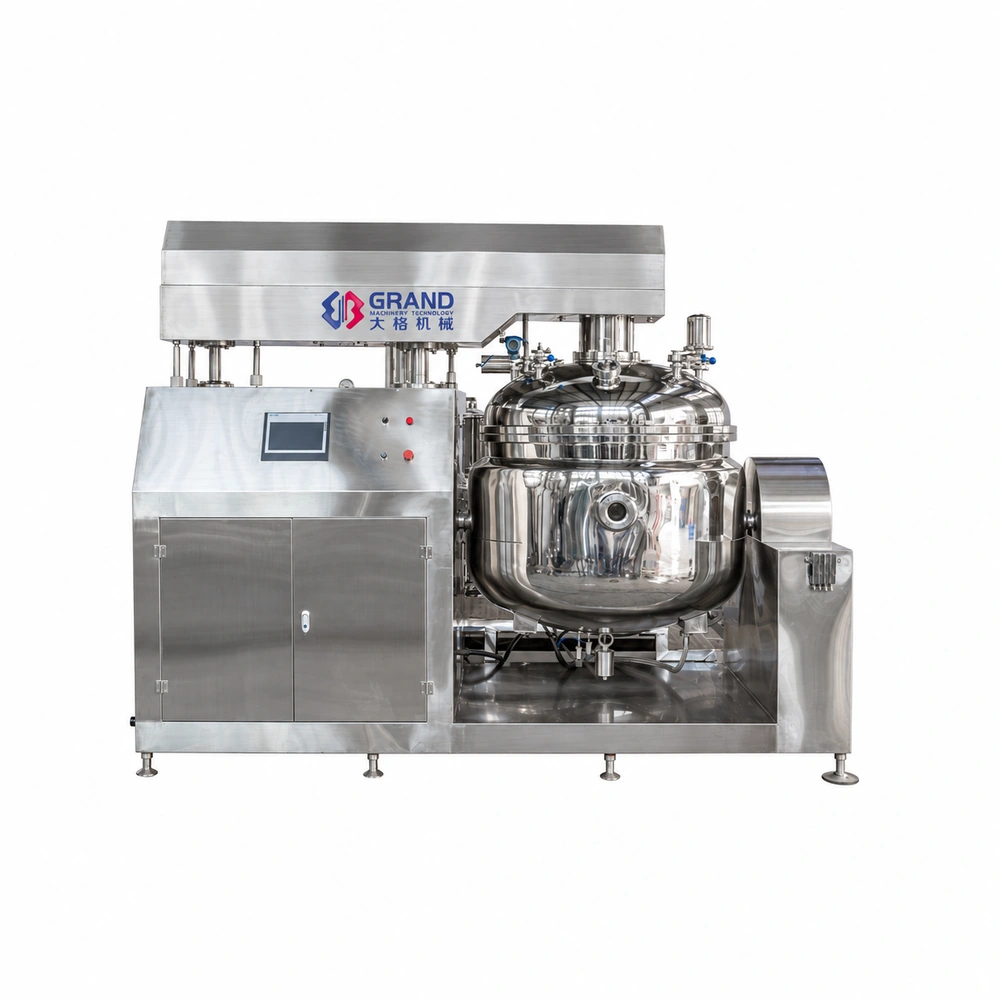
Quick Fit Check: Should You Shortlist the CB500?
Swipe horizontally to view all columns.
| Your requirement | How to approach the CB500 |
|---|---|
| A main working batch of 500 L | Use the published working volume as the starting point; confirm the usable range for your formulation. |
| Both bulk mixing and high-shear dispersion/emulsification | Review the separate frame-agitator and high-shear homogenizer duties. |
| Oil-phase preparation before main-vessel processing | Check the separate oil tank against your actual phase quantity and preparation sequence. |
| Air management during mixing | Discuss whether vacuum processing is appropriate for the ingredients and process. |
| Guaranteed droplet size, cycle time or saleable output | Define a test method and acceptance evidence; these results cannot be inferred from the model name. |
The CB500 is worth reviewing when these requirements align. If your normal batch is much smaller, or your process specifically calls for another homogenization technology, start with a different configuration rather than forcing the formulation to fit this machine.
CB500 Specifications for Batch Planning
Use these CB500 specifications for initial equipment selection. Set process temperatures, mixing speeds and vacuum stages according to the formulation and agreed operating limits.
Swipe horizontally to view all columns.
| Assembly / parameter | Published CB500 specification |
|---|---|
| Model | CB500 |
| Main vessel working volume | 500 L |
| Main vessel total volume | 620 L |
| Main-vessel slow agitator | Frame type; 3.7 kW; 0–50 rpm, variable frequency |
| High-shear homogenizer | 7.5 kW; 0–3000 rpm, variable frequency |
| Separate oil pretreatment tank working volume | 500 L |
| Oil-tank agitator | Turbine type; 1.5 kW; 0–960 rpm, variable frequency |
| Main vessel vacuum degree | −0.09 MPa |
| Vacuum pump | Water ring; model 2BV2071; 4 kW |
| Main vessel maximum working temperature | ≤130°C |
| Oil pretreatment tank maximum working temperature | ≤110°C |
| Main vessel jacket working pressure | 0.3 MPa |
| Oil tank jacket working pressure | 0.3 MPa |
| Operator controls | Touchscreen and push buttons |
Three distinctions prevent expensive misunderstandings:
- 500 L is the main working volume; 620 L is the main vessel’s total volume. Do not use the larger number as the production batch rating.
- The separate 500 L oil tank does not create a 1,000 L finished batch rating. It serves ingredient preparation, and its use depends on the formulation.
- Jacket pressure and vessel vacuum are different specifications. The 0.3 MPa jacket figure is not a high-pressure homogenization rating. Confirm the pressure reference and operating limits in the technical documents rather than converting the vacuum figure into an assumed absolute pressure.
For more equipment details, review the CB500 product specification.
Understand the Three Processing Duties Before Comparing Machines
Bulk agitation moves the batch
The frame agitator and homogenizer have different jobs. Bulk agitation moves material through the vessel; high-shear processing acts more intensely in a localized working zone. A buyer should review circulation with the actual viscosity and batch level, not assume that a powerful homogenizer alone ensures uniform processing everywhere.
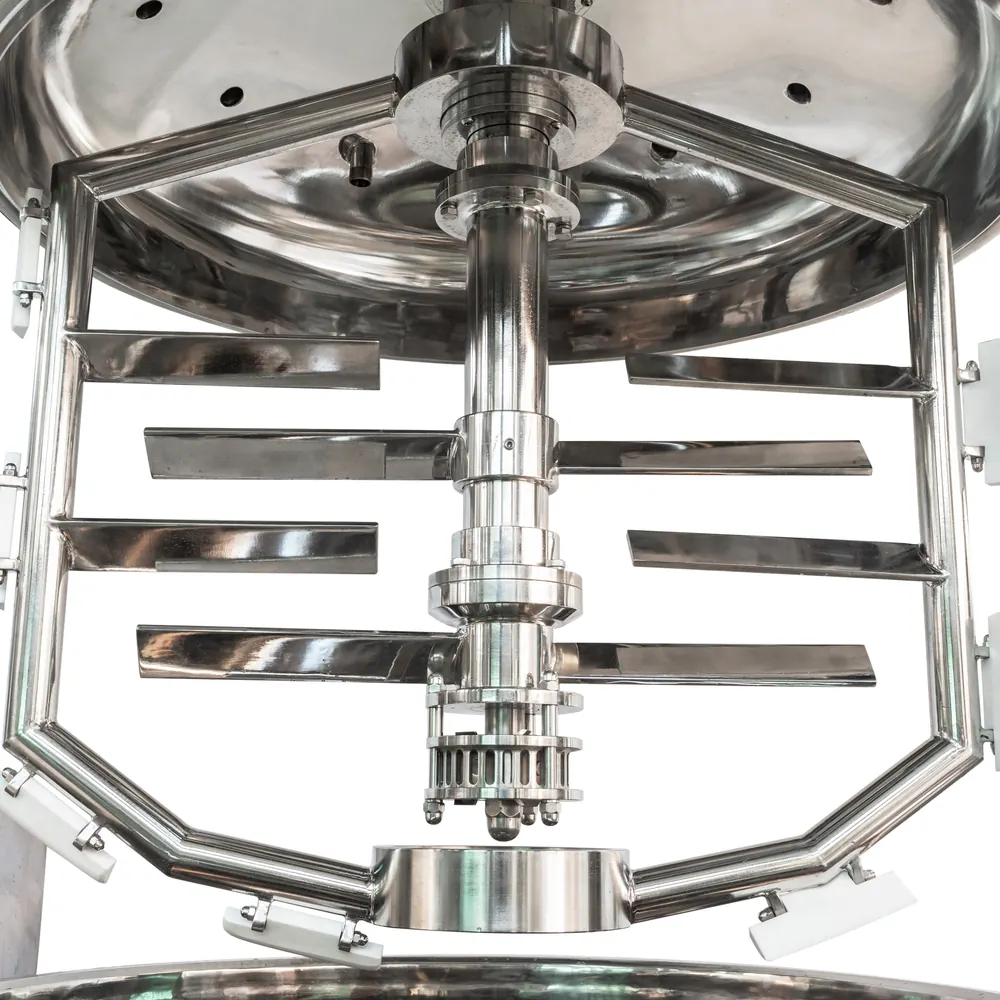
Raised CB500 mixing assembly with a central shaft and surrounding frame agitator.
High shear is not the same as high pressure
In a rotor–stator homogenizer, a rotating element works near a stationary element to generate intense mechanical shear. High-pressure homogenization uses a different mechanism, forcing material through a restrictive passage under pressure. The distinction is described in Hockmeyer’s technical explanation listed below.
The CB500 uses high-shear homogenization. Compare the proposed working-head design, circulation and formulation requirements when selecting a machine; different homogenization technologies serve different process needs.
Rotor geometry, formulation, circulation and processing history affect the result. Silverson’s scale-up guidance likewise identifies several interacting variables rather than one universal rule. Consequently, 0–3000 rpm is a speed range, not a guaranteed droplet size, emulsion stability period or batch time.
Vacuum addresses air management
Reduced pressure can help remove entrained air where appropriate. It does not replace emulsification, formulation development or quality testing. ROSS’s vacuum-mixing guidance also discusses bubbling, volume changes and the possible loss of volatile ingredients.
For a CB500 project, agree the vacuum stage and equipment limits for the formulation. Account for foaming, changes in batch volume and ingredients that may be lost under reduced pressure.
Match the Application to the Actual Product Range
The CB500’s published application scope includes cosmetic creams and pastes, compatible lotion bases and personal-care blends, compatible food emulsions and viscous mixtures, and selected ointment bases or specialty dispersions.
These are application starting points, not blanket approvals. For a cream or paste project, provide the phase composition, viscosity at a stated temperature, temperature-sensitive ingredients and required finished-product characteristics. For food or topical-product production, also define the contact-material, cleaning and documentation requirements for the specific formulation and facility.
Do not assume suitability for sterile processing, aggressive solvents, explosive atmospheres or a specified nano-emulsion simply because another industry uses homogenizers. Those requirements need their own equipment and process assessment.
For broader formulation-selection background, see GRAND’s emulsification mixer guide for cream and lotion production. This article concentrates on the CB500 procurement decision.
Compare the Quotation Scope, Not Only the Machine Price
A useful quotation separates the documented base specification, project options and exclusions. Request a written scope covering the following points.
Materials, layout and utilities
Confirm product-contact material grades, seals and compatibility with the formulation and cleaning chemicals. Request an installation drawing showing the footprint, operating clearance, lifting/access space and service connections.
Specify the heating medium, heating capacity and cooling duty in the project proposal, together with the electrical supply and utility requirements. A maximum vessel temperature is an equipment limit; the formulation determines the required processing temperature.
Controls and automation
The published CB500 configuration identifies touchscreen and push-button operation, with variable-frequency adjustment for the listed mixing drives. Ask which PLC/HMI hardware, feedback instruments, recipe functions, alarms, interlocks and records are actually included in the proposed supply.
Include the required recipe handling, data records and diagnostic functions in the quotation checklist. Review the hardware and software scope together with the proposed acceptance tests.
Cleaning, transfer and services
Agree cleaning access, drainage and the intended cleaning method. Include any required cleaning verification and documentation in the acceptance plan.
Also define discharge and transfer arrangements, spare parts, documentation, packing, freight, commissioning and training. Record which items are included, optional or supplied by the buyer. This lets you compare competing proposals on the same basis.
Where the CB500 Fits in the GRAND Range
Use capacity to build a shortlist, then compare process capability and configuration separately.
Swipe horizontally to view all columns.
| Model | Published volume basis | Homogenizing / emulsifying drive | Buying consideration |
|---|---|---|---|
| CB100 | 100 L working capacity; 160 L main vessel | 3 kW; 0–3500 rpm | Review for a smaller working batch. |
| CB150 | 150 L working capacity; 220 L main vessel | 3 kW; 0–3500 rpm | Review its own vessel and configuration details. |
| CB500 | 500 L working volume; 620 L main vessel | 7.5 kW; 0–3000 rpm | Review a 500 L batch with the documented oil-pretreatment and vacuum system. |
These are not interchangeable scale-up settings. A larger motor or a different maximum speed does not establish equivalent product quality across models. Explore GRAND’s emulsifying mixer range when your required batch or process differs.
Qualify the Selection Before Approving the Order
Use this purchasing and application-review workflow to organize the CB500 selection decision, from product requirements to a written configuration and acceptance plan.
Match the equipment to the formulation, resolve selection questions and agree the scope before placing an order.
Agree an acceptance plan that answers:
- What material is being assessed? Identify the formulation revision, batch size and relevant ingredient properties.
- What result counts as acceptable? Select relevant measures such as appearance, viscosity under stated test conditions, dispersion or droplet-size criteria where needed, and retained-sample evaluation.
- Which configuration produced the evidence? Record the model, working head, batch size and operating conditions used for the assessment.
- What is being demonstrated? Separate a mechanical run test from product trials and any agreed factory acceptance test. Define the scope, responsibilities and evidence before ordering.
Include preparation, heating, mixing, cooling, discharge and cleaning in production planning. A 500 L batch rating alone cannot establish hourly saleable output. If a trial misses the criteria, review the formulation, process and equipment selection rather than assuming that more speed will solve the issue.
Why Consider GRAND for the Project?
GRAND’s company information identifies its Wenzhou manufacturing operation and Guangzhou sales support. Its published range lets buyers discuss a named mixer configuration alongside downstream equipment requirements.
For a suitable product intended for tubes, tube filling and sealing equipment can be reviewed as a separate downstream stage. Transfer conditions, holding requirements, filling compatibility and line balance still need project-specific agreement; the mixer is not itself a filling or sealing machine.
Request a written equipment proposal covering the supplier entity, equipment configuration, testing, documentation and service scope.
Frequently Asked Questions
Can the CB500 process a full 620 L batch?
The published main-vessel working volume is 500 L; 620 L is total vessel volume. Use the working-volume figure for initial selection and confirm the usable batch range for your material.
Can it run significantly smaller batches?
Provide your smallest planned batch so liquid level, working-head coverage and circulation can be assessed for your formulation. Agree the usable batch range during equipment selection.
How should I specify droplet size and hourly output?
Define the target result, measurement method and acceptance limits for your formulation. Plan hourly output using the complete cycle, including preparation, heating, mixing, cooling, discharge and cleaning. Record the agreed performance criteria and verification method in the technical proposal.
Which control and cleaning features should I specify?
The CB500 has touchscreen and push-button controls. List the required control hardware, recipe functions, alarms, records and cleaning method in your enquiry, then review the itemized scope for the quoted machine.
What determines the quotation?
The agreed equipment configuration and supply scope: materials, controls, utility arrangements, transfer and cleaning requirements, testing, documentation and services. Provide your process information so the quotation can distinguish included equipment from options and exclusions.
Request a CB500 Homogenizer Mixer Review and Quote
Start with your product, normal batch volume and installation country. If available, add:
- Minimum and maximum batches, viscosity and measurement temperature.
- Oil-phase quantity, ingredient sensitivities and process-temperature requirements.
- Vacuum needs and finished-product acceptance criteria.
- Cleaning expectations, contact-material requirements and factory utilities.
- Installation space, downstream equipment and target project schedule.
You do not need every answer before the first discussion. Identify the missing items so they can be resolved in the technical proposal.
Request a project-specific CB500 quotation · Review the CB500 specifications Mention CB500 / 500 L homogenizer mixer in your enquiry and describe the product you plan to make.
Technical References
For background on mixing mechanisms, vacuum processing and scale-up, see these technical resources:


Sales Manager